/en/articles/twilio-gives-you-until-february-18-2027-to-drop-old-ciphers-if-your-whatsapp-bot-lives-on-an
Twilio gives you until February 18, 2027 to drop old ciphers: if your WhatsApp bot lives on an ancient server, test it now
Twilio extended to February 18, 2027 the deadline for its REST API to accept only four TLS 1.2 cipher suites (ECDHE with AES-GCM) and the AES-GCM ones in TLS 1.3. WhatsApp bots that send from old systems, such as Windows Server 2012 R2, may go silent: the test at tls-test.twilio.com already shows who breaks.

Twilio moved the date again. In its November 11, 2026 changelog it announces an extension for REST API customers to move to a shorter cipher list: you now have until February 18, 2027, and in the meantime it will keep accepting traffic with the old ciphers. It sounds like good news, and it's half good: that's three months, not a year. If your WhatsApp bot sends messages through Twilio from a server, a VM or a container that nobody has touched in years, on that day it can stop talking to the API without you changing a single line of code.
Watch the date: the page contradicts itself
One detail before going on, because this is where the scare can hide. The visible heading of the announcement, the bold text and the changelog listing all say February 18, 2027. But the <title> tag of the same page, and the title that gets distributed via RSS and social media, say November 18, 2027. The announcement's URL still ends in early-2026, the date it had when it was first published.
My read: the right date is the one in the body, February 2027, because it's the one Twilio puts in the text explaining the extension, and it's the one repeated by third-party coverage. The title smells like an editing mistake. But if someone on your team saw "November 2027" in a feed and relaxed, correct it today: it's better to plan with the nearest date.
What exactly changes
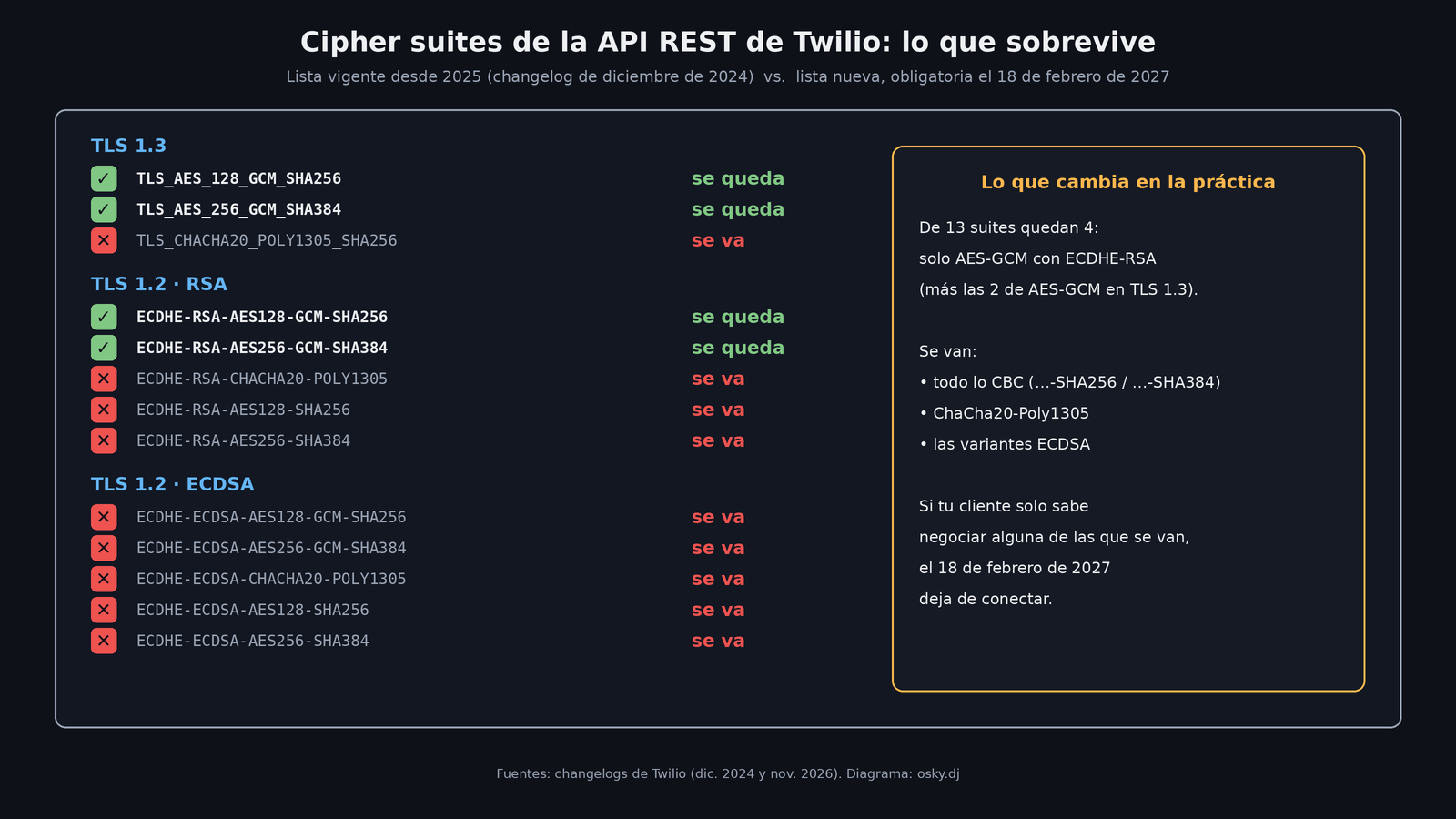
Twilio had already done a cleanup in 2025. In December 2024 it announced that all its REST APIs would support only 13 cipher suites: three for TLS 1.3, five ECDSA and five RSA for TLS 1.2, including CBC variants (…-SHA256, …-SHA384) and ChaCha20-Poly1305. That change was applied in March 2025 on almost all domains and, according to the March 2025 changelog, on api.twilio.com and ten other domains it was moved to June 2, 2025.
The new list is much shorter. According to the current announcement, what remains is:
| Protocol | Suites that stay |
|---|---|
| TLS 1.3 | TLS_AES_128_GCM_SHA256, TLS_AES_256_GCM_SHA384 |
| TLS 1.2 (RSA) | ECDHE-RSA-AES128-GCM-SHA256, ECDHE-RSA-AES256-GCM-SHA384 |
Twilio doesn't publish a list of "what's going away"; I worked that out by comparing the two announcements. Out go everything CBC, ChaCha20-Poly1305 (in TLS 1.3 too) and the ECDSA variants. In short: either you speak TLS 1.3 with AES-GCM, or you speak TLS 1.2 with ECDHE key exchange and AES-GCM. Nothing else.
Why it matters for a WhatsApp bot
When your bot replies on WhatsApp through Twilio, the send is a POST call to https://api.twilio.com/2010-04-01/Accounts/{AccountSid}/Messages.json, the same one used for SMS. The Message resource reference says so, and the examples in the WhatsApp documentation use that same resource with whatsapp:+… recipients. That domain is on the list of REST endpoints that the Twilio security policy applies to, along with lookups, taskrouter and others.
If the TLS handshake fails, the request dies before it reaches the API. You won't see a Twilio error code in the Console or a status webhook: you'll see a connection exception in your own log, something like "handshake failure" or a timeout. My read is that this is the dangerous part: the bot receives messages perfectly (that direction is Twilio to you), but replies don't go out, and from the outside it looks like "the bot froze."
The announcement only talks about the REST API, that is, the calls your server makes to Twilio. It doesn't mention the webhooks Twilio sends to your server.
Who's at risk
Twilio says it in general terms: anyone using legacy networking software or old operating systems. And it clarifies a point many people overlook: the Twilio library doesn't negotiate the cipher. In the announcement it explains that in the Helper Libraries that negotiation is done by the runtime and the operating system. Updating the twilio package from npm or pip helps, but it doesn't fix an old OpenSSL or an old Windows.
A concrete case, taken from Microsoft's documentation. The Windows 7 cipher table and the one for Windows 8.1 and Windows Server 2012 R2 have TLS_ECDHE_RSA_WITH_AES_*_CBC_*, TLS_DHE_RSA_WITH_AES_*_GCM_* and TLS_RSA_WITH_AES_*_GCM_* enabled by default, but no TLS_ECDHE_RSA_WITH_AES_*_GCM, which is exactly what the new list asks for in TLS 1.2. On top of that, none of those versions supports TLS 1.3. If you have a .NET Framework service on an old Windows Server that uses the system's TLS, it's the prime suspect.
Other places worth looking:
- Corporate proxies and TLS inspection appliances that get in the middle of the connection. Twilio asks you to run the test "over the same network path," proxy and firewall included.
- Containers with old base images or frozen runtimes (for example, an image from years ago that nobody rebuilds).
- Clients with the cipher list forced by hand, for example someone who left only ChaCha20 for an ARM device without AES acceleration.
The test, done for real
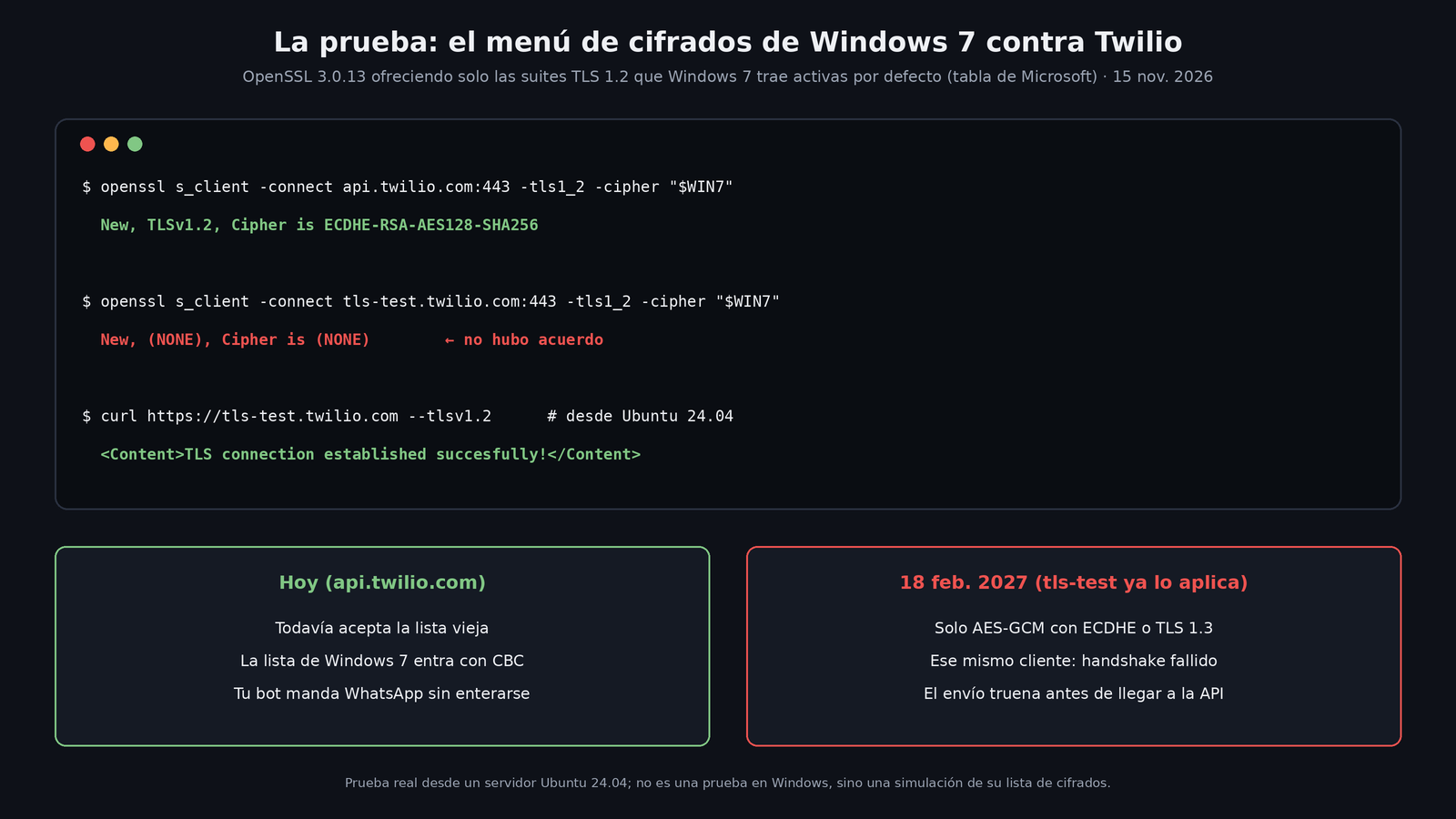
Twilio already has the new configuration on tls-test.twilio.com. I checked it today, November 15, 2026, from an Ubuntu 24.04 server with OpenSSL 3.0.13:
tls-test.twilio.comaccepted the four suites on the new list, but rejectedECDHE-RSA-AES256-SHA384,ECDHE-RSA-CHACHA20-POLY1305,AES256-GCM-SHA384andTLS_CHACHA20_POLY1305_SHA256.api.twilio.comstill accepted those same four. That's the grace period Twilio talks about.- Then I configured the client to offer only the TLS 1.2 suites that Windows 7 has enabled by default according to Microsoft. Against
api.twilio.comit negotiatedECDHE-RSA-AES128-SHA256(CBC) with no problem. Againsttls-test.twilio.comthere was no cipher in common and the handshake failed.
Honest disclaimer: I didn't test on a real Windows 7. I simulated its cipher menu with OpenSSL, so take it as a strong indication, not a certificate.
How to prepare before February 18
This is the procedure Twilio publishes in the announcement and in its monitoring guide, with a couple of notes of mine:
- Run the test from where the bot runs, not from your laptop. Same server, same runtime, same proxy. The minimum is
curl https://tls-test.twilio.com --tlsv1.2. If it responds 200 OK with an XML saying "TLS connection established," you're good. Twilio's guide has snippets for C#, Java, Node.js, PHP, Python and Ruby that use the library's own HTTP client, which is the most faithful test. - If it fails, update the operating system and the TLS library. If you use Helper Libraries, check the runtime and upgrade to the latest version of the library, as Twilio recommends.
- Run the test again after updating.
- My suggestion: keep it as a periodic check. Twilio's guide says it publishes every security change on
tls-testat least a month in advance. A cron job that hits that endpoint once a day, from production, warns you about the next change before it takes you down.
Do a full inventory. Besides the main bot, look for workers that query delivery statuses, scripts that send OTPs or alerts, and any third-party integration that uses your credentials. Any of them could be running on that old machine nobody remembers.
What's still unknown
- Whether there will be another extension. This isn't the first one, but planning around that hope is a bad idea.
- Whether the change will reach all domains on the same day. In 2025
api.twilio.comwas applied almost three months after the rest; today's announcement talks about "all REST API endpoints" with no breakdown. - What happens with Twilio's outbound webhooks: the announcement doesn't mention them.
Three months is more than enough time to run a curl. What isn't enough is finding out on February 18, from an angry customer, that your bot stopped answering.
Sources
- Twilio: Upcoming cipher suite list update for all Twilio REST API endpoints (November 11, 2026)
- Twilio Help Center: Monitoring Updates to Twilio REST API Security Settings
- Twilio: Upcoming Certificate Rotation and Ciphersuite List Update (December 2024)
- Twilio: Update in the supported cipher suites in Twilio REST API endpoints (March 2025)
- Twilio Docs: Message resource
- Twilio Docs: WhatsApp Business Platform with Twilio
- Microsoft Learn: TLS Cipher Suites in Windows 7
- Microsoft Learn: TLS Cipher Suites in Windows 8.1
- Digimar Solutions: Prepare Twilio Integrations for New TLS Ciphers