/en/articles/cloudflare-sees-50-families-of-ai-agents-attacking-in-parallel-heres-its-recipe-for-defending
Cloudflare sees 50 families of AI agents attacking in parallel; here's its recipe for defending yourself
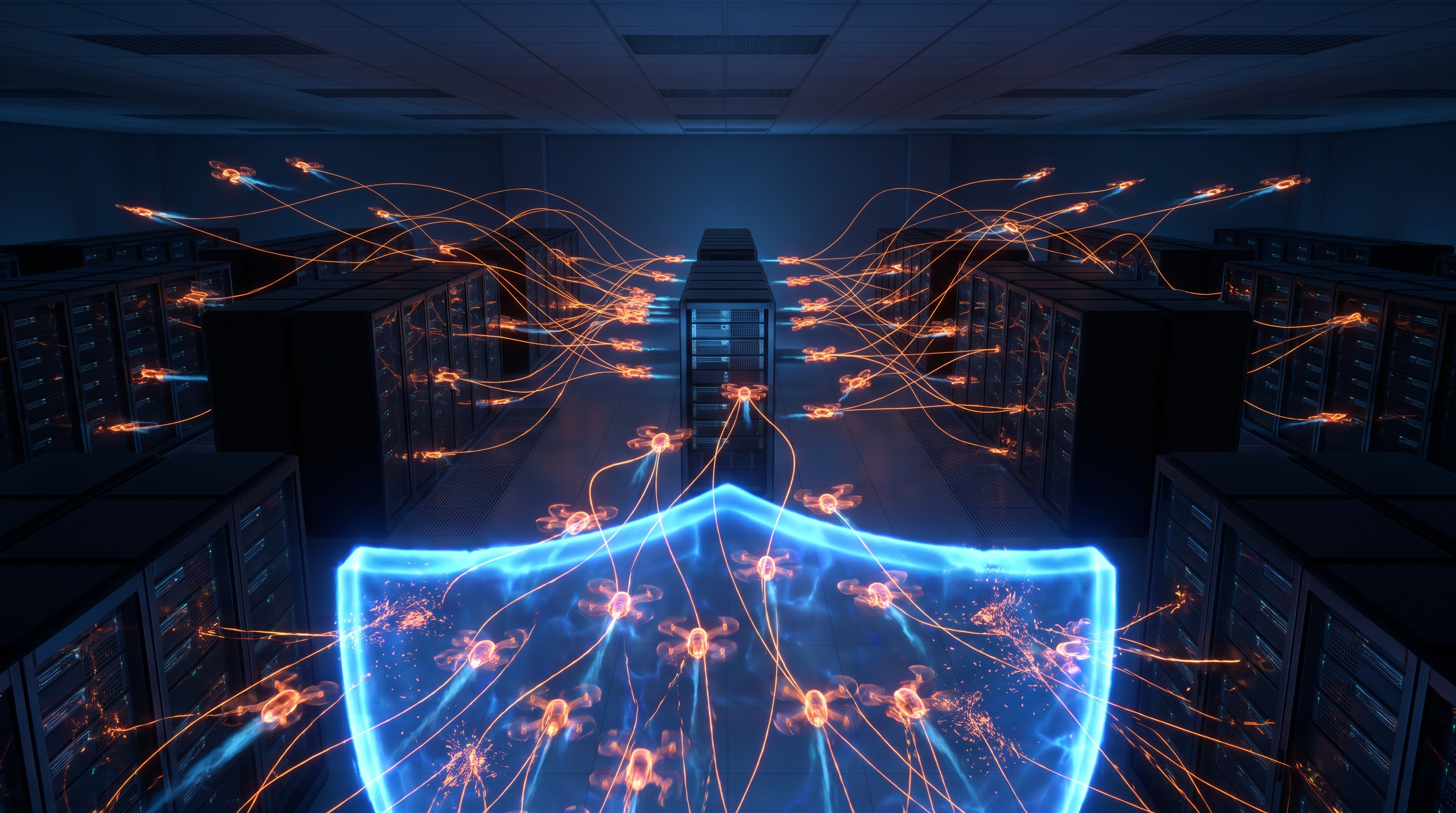
Cloudflare published on November 13 what it is seeing across its network about AI pentesting orchestrators: open-source frameworks that set multiple language-model agents to scout, probe, and attack exposed infrastructure in parallel, without ever getting tired. The numbers it gives are worth taking seriously: in just three days it saw more than 50 families of these frameworks trying to scan its customers, from thousands of IP addresses, and the daily volume of requests from these tools grew more than 30x since October 1. For anyone with a server, an admin panel, or an API exposed to the internet, this is no longer a conference talk topic: it's traffic that has probably already passed through your logs.
From a tool to a hydra
It all revolves around ARTEX, an open-source "agentic" pentesting system. According to Help Net Security, a user named Autumn-27 published it on GitHub on July 26, 2026, intended for authorized security testing. Attackers adopted it within weeks. Google Threat Intelligence Group and Mandiant say they have seen it in real incidents since late August, alongside other similar frameworks such as PentAGI, Hexstrike, and CAIRN, in the hands of extortion groups and suspected espionage operators.
According to Cloudflare, Autumn-27 took down the original repository on October 8, with a message in Chinese saying the malicious use "goes completely against its original intent." The problem is that it was already too late. Cloudflare counts more than 12,000 repositories and several hundred unique forks descended from the original, plus hundreds of similar frameworks created since. As of November 12, ARTEX and its derivatives account for more than 60% of the orchestrators of this type that Cloudflare has identified.
Cloudflare describes it as a hydra effect: taking down the original repository, and the media coverage it got, coincided with a sharp acceleration in the number of unique instances. Since the takedown, traffic from these tools has increased more than tenfold.
What makes an orchestrator different
A traditional vulnerability scanner walks through a list. An orchestrator, as Cloudflare describes it, maps assets and the environment into a graph and sets multiple independent agents to enumerate, verify, prototype, and attack in parallel, "at the speed of inference." They can connect MCP servers and classic pentesting tools in new ways, and some accept instructions from the operator about which task to pursue.
Cloudflare sums up the shift in four points:
- Human skill is no longer the limit. The harness observes, prioritizes, decides, and acts on its own.
- Speed. Multiple agents in parallel against the same target.
- Scale. A single operator can go after several organizations at once.
- Small mistakes no longer go unnoticed. These tools systematically test every exposed service and its configuration.
In its article it compares the five most popular ones (all with more than a thousand stars on GitHub): ARTEX, LuaN1aoAgent, Decepticon, Cairn, and PentestGPT-Agent. Several run in Kali containers with root permissions and can write their own tools on the fly. Decepticon ships with specific skills for Active Directory and for moving between clouds; LuaN1aoAgent includes SSH and Chisel tunnels to reconnect if it gets cut off. Cairn doesn't even ship its own agents: it hands the work off to harnesses that already exist, like Codex or Claude Code.
CERT-EU adds a detail that matters: ARTEX relies on configurable rules and the model itself to respect scope and avoid destructive actions, but it has no real technical lock. It also doesn't ship its own model; the operator plugs in whatever LLM provider they want.
The case that should worry anyone with a CI/CD pipeline
The most concrete part of the report comes from Cloudflare's incident response team, Cloudforce One. In several investigations over the past eight weeks, an attacker first got into a big cloud (what Cloudflare calls a "hyperscaler") and from there jumped straight to the customer's Cloudflare account. The root cause kept repeating: static tokens, with no expiration date, stored inside CI/CD pipelines and with broad access across environments.
In one case, ARTEX obtained an account-level API token that was used for CI/CD, with no IP restriction or rate limit. With it, it created a bunch of Workers with names like artex-*, artex-pgrecon-*, or artex-pgw-*, each with a different function. Cloudflare measured more than 69 requests per minute against various parts of the customer's infrastructure and 400 database dump requests in one hour, plus attempts at persistence and at validating session tokens from other applications. Cloudflare believes a good part of that was barely guided by a human.
My take: this is not a new vulnerability or an exotic exploit. It's the same old credential hygiene problem (the eternal token with god-level permissions that someone left in the pipeline "temporarily" in 2023), only now it's exploited by a machine that never sleeps and chains one finding to the next in seconds.
The "Modern Security Model" Cloudflare proposes
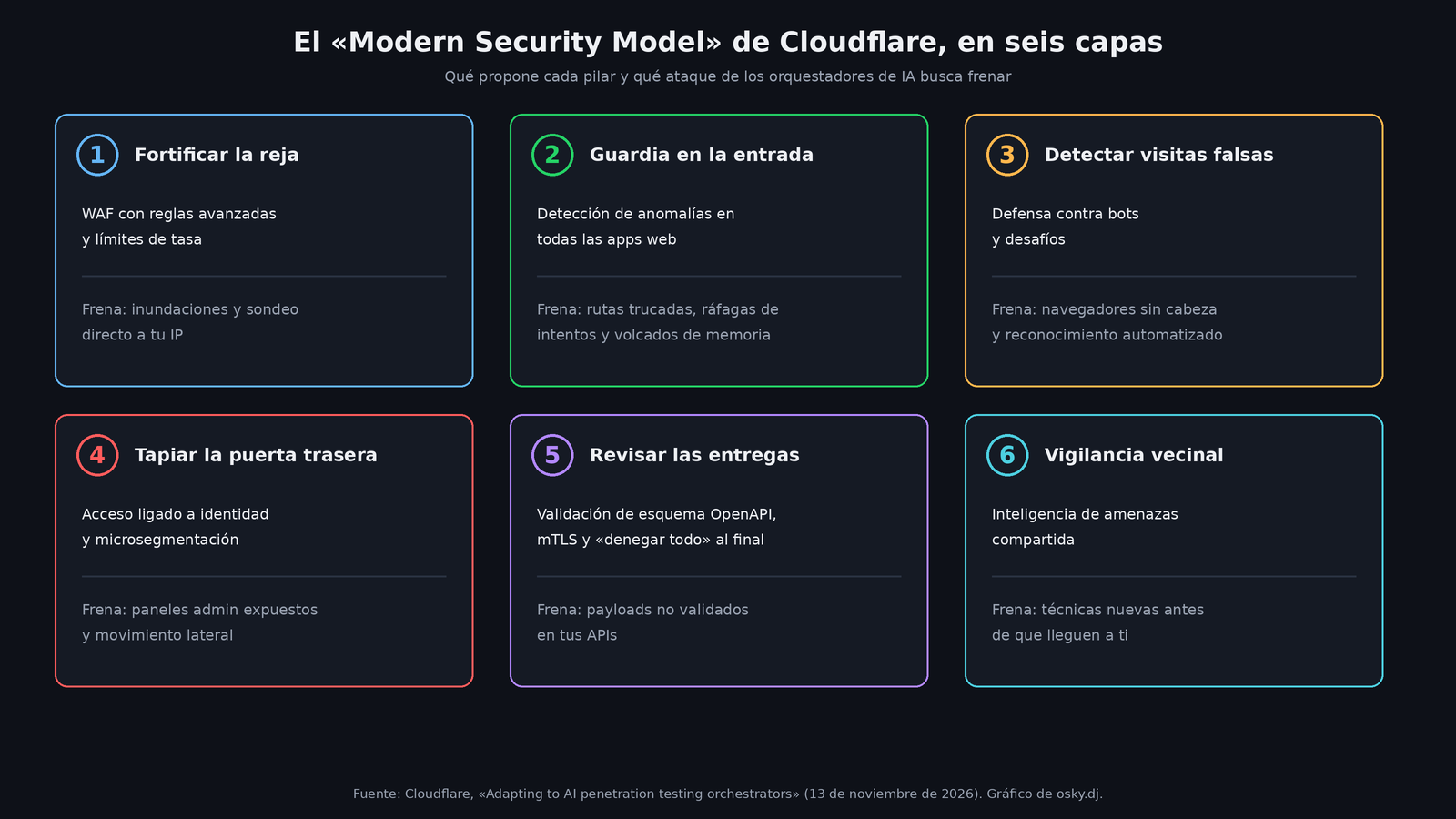
Cloudflare's answer is what it calls the Modern Security Model, explained with the metaphor of a house on an estate. It has six pillars:
- Fortify the gate: web application firewall (WAF) with advanced rules and rate limits, plus network traffic control against volumetric attacks.
- A guard at the entrance: anomaly detection across all web applications. No hundreds of attempts in seconds, no tampered paths like
//front-door//back-room/, no downloads of diagnostic dumps. At this point it also recommends FIDO security keys. - Spot fake visitors: bot defense and challenges, because headless browsers and recon tools don't behave like people.
- Brick up the back door: identity-bound access (Zero Trust) for admin panels, endpoints like
/actuator, and remote gateways, so that from the outside they don't even exist. And microsegmentation so a stolen credential can't hop from development to production. - Check the deliveries: OpenAPI schema validation on APIs, mTLS for trusted connections, and an explicit "deny all" rule at the end of every rule set.
- Neighborhood watch: threat intelligence to learn about new techniques before they reach you.
Let's be clear: almost every pillar links to a Cloudflare product, and the article closes with the contact for its sales team. It's an intelligence report and a brochure at the same time. But the underlying ideas aren't exclusive to Cloudflare: Google and Mandiant recommend isolating the control plane, using short-lived credentials, least privilege, segmentation, and behavior-based detection, and CERT-EU calls for reducing internet exposure, taking admin panels off the public network, and patching what's exposed first.
What to do this week, even if you're not a bank
If you run a VPS, a Drupal site, a bot with webhooks, or any public API, the practical list almost writes itself from the sources:
- Check your tokens. The ones for CI/CD, your cloud provider, and your CDN. If any of them doesn't expire, has full account permissions, or has no IP restriction, that's the first one to change. According to Help Net Security, Microsoft and GitGuardian recommend treating any secret that has touched a public repository as compromised and rotating it without waiting for proof.
- Hide the admin stuff. Panels, phpMyAdmin, diagnostic endpoints, and SSH shouldn't respond to just anyone. Put them behind a VPN, an identity-aware proxy, or an IP allowlist.
- Set rate limits on login, on the API, and on anything that returns data in volume. The case of 400 dumps in an hour wouldn't have been so easy with a reasonable limit.
- Don't let "minor" findings slide. CERT-EU insists on keeping them in the remediation cycle, because these tools chain small mistakes until they become a serious attack path.
- Clean up your error messages. The less they reveal about your stack, the less the agent has to get its bearings.
Looking ahead, Help Net Security reports that Google expects noisy attacks with little or no human involvement within one to three months, and fully autonomous, stealthier attacks within three to six. For now, these tools favor speed over stealth and leave traces that help detect them. That's the good news. The bad news is that this window has an expiration date.
This comes from Cloudflare's report and the cited sources; I didn't test any of these frameworks.
Sources
- Cloudflare: Adapting to AI penetration testing orchestrators: The Modern Security Model
- Google Threat Intelligence Group: ARTEX and Friends: Enter Agentic Offensive Frameworks
- CERT-EU: From Penetration Testing to Cyber Threat: Beware of ARTEX
- Help Net Security: ARTEX goes from pentesting tool to attacker staple in three months