/en/articles/apache-2-4-71-patches-a-critical-http-2-rce-the-bug-was-a-single-line
Apache 2.4.71 patches a critical HTTP/2 RCE: the bug was a single line

If you have an Apache with HTTP/2 turned on in any version between 2.4.55 and 2.4.70, you've got homework today. On November 11, 2026, the Apache HTTP Server project released version 2.4.71 and, along with it, a security advisory rating CVE-2026-119618 as critical: a race condition in mod_http2, inside the assign_headers() function, that according to Apache "can lead to RCE", that is, remote code execution. The security firm Wiz, which is the one that brought the topic to the front page of Hacker News, adds that the attacker doesn't need to authenticate. The good news: the patch is already in Debian and Ubuntu, and it's a single line. The bad news: Apache is still behind a huge number of PHP sites, hosting panels and forgotten proxies, and "I'll update it on Monday" is exactly how these things end up in a forensic report.
What Apache published
The 2.4.71 announcement recommends it over all earlier versions, and the 2.4 branch vulnerabilities page details that it fixes three CVEs: one critical, one important and one low. The one that matters is this:
- CVE-2026-119618 (critical): Apache describes it as "concurrent execution using a shared resource with improper synchronization" in
assign_headers()ofmod_http2. - Affected versions: Apache HTTP Server from 2.4.55 to 2.4.70, and the
mod_h2module distributed separately on GitHub, from 2.0.8 to 2.0.42. - Who found it: two separate teams. Anthropic's "OSS Scanner" (registered as ANT-2026-MAPKT6MZ), which reported it on October 26, and Anthony Weems and Simon Scannell, from Google Cloud Vulnerability Research, who reported it on November 3.
- Fix: commit 824beab, which landed in the 2.4 branch on that same November 11.
Eight days between the first report and the second, and fifteen days between the first one and the published patch. My take: when two different teams, one of them an automated AI scanner, arrive at the same bug in under two weeks, you'd better assume they're not the only ones with it in their sights.
What Wiz adds (and what is still unknown)
The Wiz analysis is the most complete secondary source. According to Wiz:
- A remote, unauthenticated attacker can corrupt heap memory and end up executing arbitrary code with the privileges of the web server process.
- At the time of its publication there was no public exploit and no reports of active exploitation.
- According to their data, 64% of the cloud environments it monitors have resources running vulnerable versions and 51% have instances exposed to the internet. Wiz clarifies that those figures don't take configuration into account, meaning they don't distinguish whether HTTP/2 is enabled.
What's still unclear is how easy it is to exploit in practice: winning a race condition to turn memory corruption into code execution is usually hard, but "hard" is not "impossible", and neither Apache nor Wiz has published a technical exploitability analysis. Ubuntu, for its part, gave it high priority with a four-word justification: "This is a remote RCE".
The patch: a single line
Here's the most interesting part for anyone who reads code. Commit 824beab changes a single line in modules/http2/h2_request.c. When a request carries Content-Type but the stream has already ended, the module adds Content-Length: 0. Before, it wrote it to req->headers, the h2_request structure that represents the request as it arrived over HTTP/2. Now it writes it to r->headers_in, the request_rec that belongs to that request inside Apache.
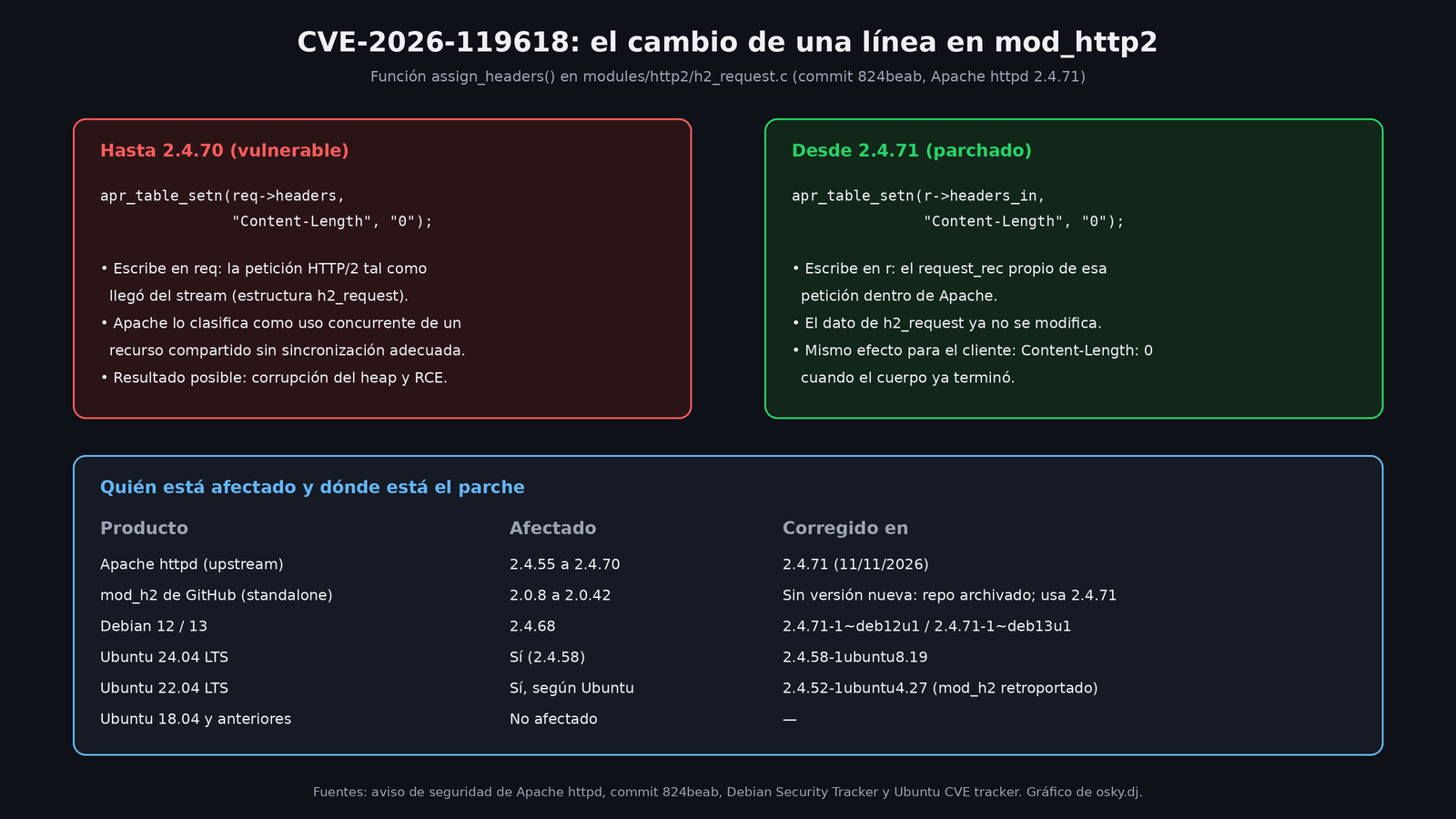
My read of the diff: the bug wasn't writing the wrong value, but writing it in the wrong place. Modifying a structure that is shared between threads without synchronization is exactly what the CVE's category describes, and the fix consists of no longer touching it. In the Hacker News comments, where the thread passed 360 points, a commenter pointed out that having two variables named r and req in the same function, for two representations of the same request, is begging for this kind of bug. Hard to disagree.
How to know if it hits you
You need two things to be exposed: an affected version and mod_http2 loaded with HTTP/2 enabled in some VirtualHost. Quick checks (standard Apache and package manager commands; swap apache2ctl for apachectl or httpd depending on your distro):
- Version:
apache2ctl -v. - Loaded module:
apache2ctl -M | grep http2. - Active protocols: look for the
Protocolsdirective in your configuration. If it includesh2orh2c, HTTP/2 is on.
Watch out with distros: the version number isn't enough. Debian and Ubuntu put the patch in their own packages without moving to 2.4.71 in every case. According to the Ubuntu tracker, the fixed versions are:
- Ubuntu 24.04 LTS:
2.4.58-1ubuntu8.19. - Ubuntu 22.04 LTS:
2.4.52-1ubuntu4.27. Although 2.4.52 is earlier than the official range, Ubuntu considers it affected because it backported newer versions of the module. - Ubuntu 20.04: only with Ubuntu Pro (ESM).
- Ubuntu 18.04 and earlier: not affected.
On Debian, according to its security tracker, the fix arrived with DSA-6620-1 for trixie (2.4.71-1~deb13u1) and DLA-4902-1 for bookworm (2.4.71-1~deb12u1).
In practice: sudo apt update && sudo apt install --only-upgrade apache2 and restart the service. If you compile Apache yourself or use a container image, the reference is 2.4.71.
The odd case: standalone mod_h2
If instead of the mod_http2 that ships with Apache you use the standalone module from GitHub, there's a detail Wiz doesn't explain well. Their table says the fixed version is "2.0.42 and newer", but Apache's official advisory lists 2.0.42 as affected. And the mod_h2 repository has been archived since June 2026, with 2.0.42 as the last release. My take: there's no fixed standalone version to wait for; the way out is to use the module that ships with Apache 2.4.71.
If you can't update today
Wiz proposes a temporary mitigation: turn off HTTP/2 and leave only HTTP/1.1 with Protocols http/1.1 in the configuration. The Apache HTTP/2 documentation confirms that Protocols can be set globally or per VirtualHost, so check both places; a vhost with Protocols h2 http/1.1 overrides the global one. I haven't tested it against this bug; this comes from Apache's documentation and Wiz's recommendation. The cost is performance, since you lose multiplexing, but it's better than leaving the door open.
Two notes from my own harvest:
- Having a CDN in front doesn't save you by itself. If the origin accepts direct connections from the internet, someone who finds its IP can talk to it over HTTP/2 without going through the CDN. Lock the origin down to the provider's IPs or update.
- This CVE is in Apache's
mod_http2. Nginx, Caddy, OpenLiteSpeed and company have their own HTTP/2 implementations, so it doesn't apply to them directly. But if your main server is something else and you have an old Apache hiding behind it, acting as a proxy or serving a panel, that one counts too.
The other two CVEs in 2.4.71
Since you're going to update anyway, the same release fixes:
- CVE-2026-106023 (important): a NULL pointer dereference in
mod_md, the module that manages ACME certificates, which takes down child processes. It affects 2.4.30 to 2.4.70. - CVE-2026-109163 (low): a one-byte stack overwrite in
mod_vhost_alias, which showed up after the fix for CVE-2026-63292. It affects only 2.4.69 and 2.4.70.
To give you a sense of the pace: 2.4.69 came out on October 1 with 20 CVEs fixed. If your patching policy for Apache is "whenever I remember", November is a good month to change it.
Sources
- Apache HTTP Server 2.4 vulnerabilities: CVE-2026-119618
- Apache HTTP Server 2.4.71 announcement
- Commit 824beab in apache/httpd
- Wiz: Critical RCE Vulnerability in Apache HTTP Server
- Ubuntu: CVE-2026-119618
- Debian Security Tracker: CVE-2026-119618
- HTTP/2 documentation in Apache httpd 2.4
- mod_h2 releases on GitHub
- Hacker News discussion