/en/articles/twilio-voice-now-sounds-hd-what-amr-wb-changes-for-voice-bots-and-ivrs
Twilio Voice Now Sounds HD: What AMR-WB Changes for Voice Bots and IVRs
Twilio has started negotiating the AMR-WB wideband codec with carriers, first in the United States. HD audio applies to ConversationRelay, Say, Play, and Gather, and Voice Insights flags which calls made it and which were degraded.
Twilio has started connecting Twilio Voice calls with HD audio. According to its changelog from November 16, 2026, the platform now negotiates the AMR-WB wideband codec with carrier networks that support it, starting in the United States and adding more markets "over time." If you build voice bots with <ConversationRelay>, IVRs with <Gather>, or messages with <Say> and <Play>, this matters: for decades, the phone call has been the link that turns a decent synthetic voice into something that sounds like AM radio. Now, for part of the traffic, that link gets wider.
What Twilio announced
The announcement is short, but precise. Here are the points, all from the changelog:
- Twilio Voice calls "can now" connect in HD voice, with "clearer and more natural" speech.
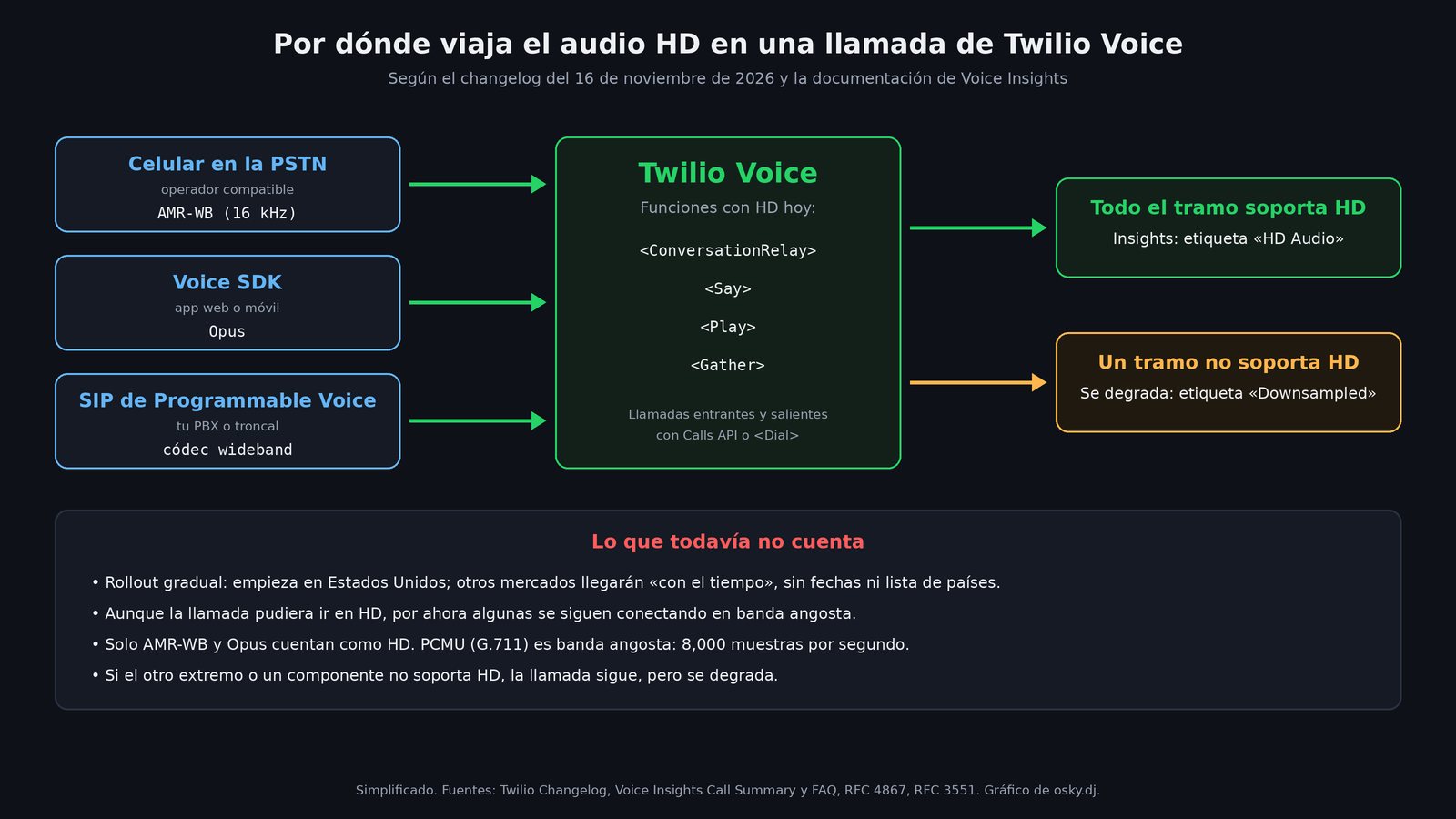
- Twilio negotiates AMR-WB with compatible carrier networks. It starts in the United States and will expand to other markets with no dates given.
- HD applies first to inbound calls and to outbound calls made with the Calls resource or with
<Dial>. - On those calls it works with some features:
<ConversationRelay>,<Say>,<Play>, and<Gather>, and Twilio says more are coming. - Besides calls from the telephone network that negotiate AMR-WB, calls from the Voice SDK and Programmable Voice SIP that use a wideband codec stay wideband "end to end" on those same features.
- The rollout is gradual: some calls that could go HD still connect in narrowband.
Twilio marks it as general availability (GA) within the Voice API. The changelog doesn't mention any parameter you need to enable or any additional cost. It describes it as something Twilio negotiates with the carrier, not an option you switch on.
What AMR-WB is and why they call it HD
Traditional telephony uses G.711, which shows up in RTP as PCMU or PCMA. RFC 3551 defines it with a sampling rate of 8,000 Hz and 8 bits per sample. It's the classic "phone" voice: understandable, but with no sparkle.
AMR-WB, standardized by the ITU as G.722.2, works at double that. RFC 4867, which defines how it travels over RTP, explains that it samples at 16,000 Hz, processes 20 ms frames of 320 samples each, and has nine coding modes from 6.6 to 23.85 kbps. That same RFC places it as the wideband codec of third-generation cellular systems. That's where the "HD voice" of mobile calls comes from.
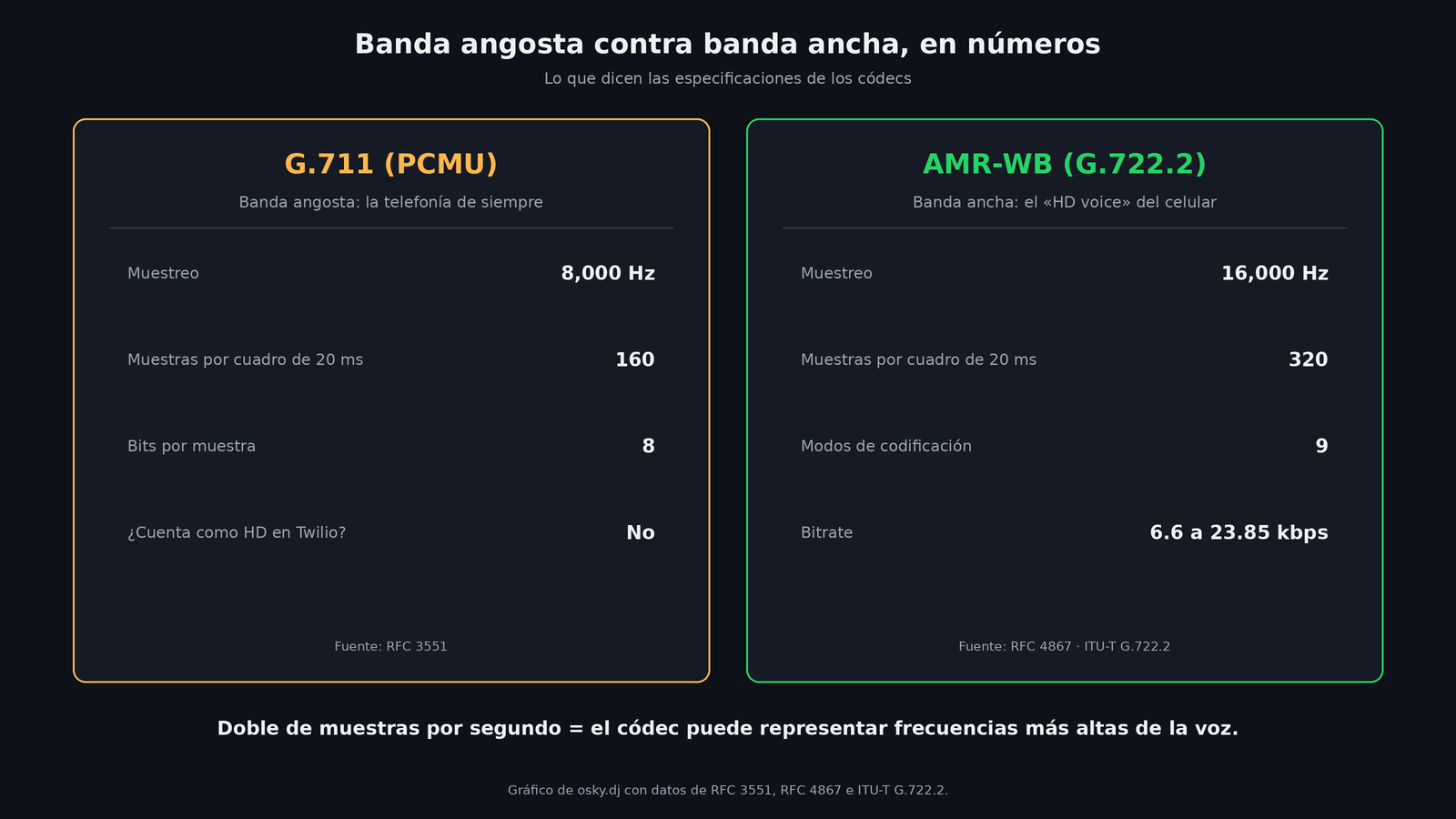
The Voice Insights FAQ defines what counts as HD for Twilio: AMR-WB, "typical of mobile calls," or Opus, "typical of Voice SDK calls." Twilio clarifies that no other codec counts. And it sets two conditions for a call to go HD: the person's device must support that codec, and it must connect to Twilio through a carrier, a SIP infrastructure, or a Voice SDK app configured to use it.
The fine print: the weakest link rules
A call isn't a single pipe. It has legs (the cell phone, the carrier, Twilio, your SIP server, the other participant), and it only takes one that doesn't support wideband to lose it. The FAQ explains this with the Downsampled label: the call entered Twilio with an HD codec, but the longest part connected to a component or to another endpoint without HD support, so Twilio lowered the audio quality to keep the call connected.
In practice, here's my take:
- A
<Dial>from an HD-capable cell phone to a landline that only speaks G.711 is going to degrade on that leg. - Features that aren't on the changelog's list (for now, only
<ConversationRelay>,<Say>,<Play>, and<Gather>) may be that component that doesn't support HD. Twilio hasn't published a list of what's left out yet. - If your PBX or your SIP trunk only offers PCMU, you won't see HD even if the carrier on the other side supports it.
How to tell if your calls are already going HD
Twilio doesn't ask you to guess. According to the changelog, calls that connected with a wideband codec carry the HD Audio label in Voice Insights, and it shows up in three places:
- The Call Summary of each call in the console.
- The Voice Insights REST API.
- Event Streams.
You can also filter the Call Insights dashboard by that label.
The Call Summary documentation adds detail in the metrics section. The Codec field shows the RTP name of the codec used on each leg, for example Opus or PCMU. Calls that carried wideband audio on that leg show up as HD Audio, and those that were degraded also show up as Downsampled. The same documentation says the full summary can take up to 30 minutes to be put together after hanging up.
Two operational details from the FAQ:
- To query metrics and events through the API or Event Streams, you need to have Voice Insights Advanced Features turned on. Without them, the API responds
401 Unauthorized. - Voice Insights keeps data for only 30 days. If you want to measure how much of your traffic goes HD month over month, export or store the data yourself.
What this means for voice bots
Here comes my take, not what Twilio said. If the channel improves, <ConversationRelay> is where it will be most noticeable. The ConversationRelay documentation describes it as the service that converts what the caller says into text, sends it to your application over WebSocket, and converts your response into speech with a TTS provider (Google, Amazon, or ElevenLabs, which is the default). The voices from those providers are generated at much higher quality than fits in 8 kHz. With narrowband, a good chunk of a neural voice's work gets lost along the way.
The other half is transcription. Twilio doesn't claim in the changelog that HD improves speech recognition. What the Call Summary does say is that checking the codec and stream conditions is useful for calls that get transcribed, and that a high MOS and low jitter help transcription accuracy. It's reasonable to expect that more bandwidth helps, but there are no published figures and I haven't measured it.
For those operating voice bots, my recommendation is concrete: before promising a client "HD audio," filter their calls by the label and see what real percentage goes out in HD and how much gets degraded.
And in Mexico?
The changelog says the United States first and gives no dates or list of countries for the rest. Calls through the Voice SDK and through SIP with a wideband codec don't depend on the cellular carrier, so, according to Twilio's description, on the supported features they should already go wideband end to end. For telephone network calls in Mexico, we'll have to wait for Twilio to announce the expansion.
I didn't test it: all of this comes from the changelog and from the official Twilio Voice and Insights documentation, plus the codec RFCs.
Sources
- Twilio Changelog: Twilio Voice now supports HD audio (November 16, 2026)
- Twilio Docs: Voice Insights Call Summary
- Twilio Docs: Voice Insights FAQ, "Why wasn't my call HD?" and "Downsampled"
- Twilio Docs: TwiML ConversationRelay
- RFC 4867: RTP payload format for AMR and AMR-WB
- RFC 3551: RTP profile for audio and video (PCMU/G.711)
- ITU-T G.722.2 (AMR-WB)