/en/articles/twilio-plans-to-stop-rejecting-a2p-10dlc-campaigns-blindly-codes-that-pinpoint-what-went-wrong-are
Twilio plans to stop rejecting A2P 10DLC campaigns blindly: codes that pinpoint what went wrong are coming on December 9
Twilio plans to introduce, starting December 9, 2026, specific error codes for A2P 10DLC campaign rejections: they point to problems in the description, the message flow, and the privacy and terms pages. What they mean and how to get ready if you register campaigns via API.

If you've ever registered an A2P 10DLC campaign on Twilio and had it sent back with a "rejected" that didn't say much, this one's for you. On November 13, 2026, Twilio posted in its changelog that, starting December 9, 2026, it plans to introduce more specific error codes for A2P 10DLC campaign registration rejections in the United States. That's about twenty new codes pointing to three specific areas of the process: the campaign description, the message flow (how people opt in), and the Privacy Policy and Terms and Conditions pages. For anyone who registers campaigns through the API, especially on behalf of clients, the difference is going from guessing what the reviewer didn't like to having a code that points to the exact field.
What Twilio announced
The notice is short and to the point. According to the Twilio changelog, the new codes identify specific registration problems, and each one links to a guide for fixing it. The package includes additional codes and also the A2P 10DLC mapping for error 30569, which already existed in Twilio's error dictionary.
Watch the verb: Twilio says it "plans to introduce" them. The date is December 9, 2026, but it's an announced plan, not something already running on every account.
This doesn't come out of nowhere. The help article "A2P 10DLC Campaign Registration Rejected" documents that since September 15, 2026 Twilio already uses codes shared between A2P 10DLC and Toll-Free Verification for finer-grained rejection reasons: Call-to-Action (CTA), Terms, and consent disclosures. The December change is, as I read it, the second turn of that same screw: fewer generic "Campaign vetting rejection" messages and more pinpoint diagnosis.
The codes, by section of the registration
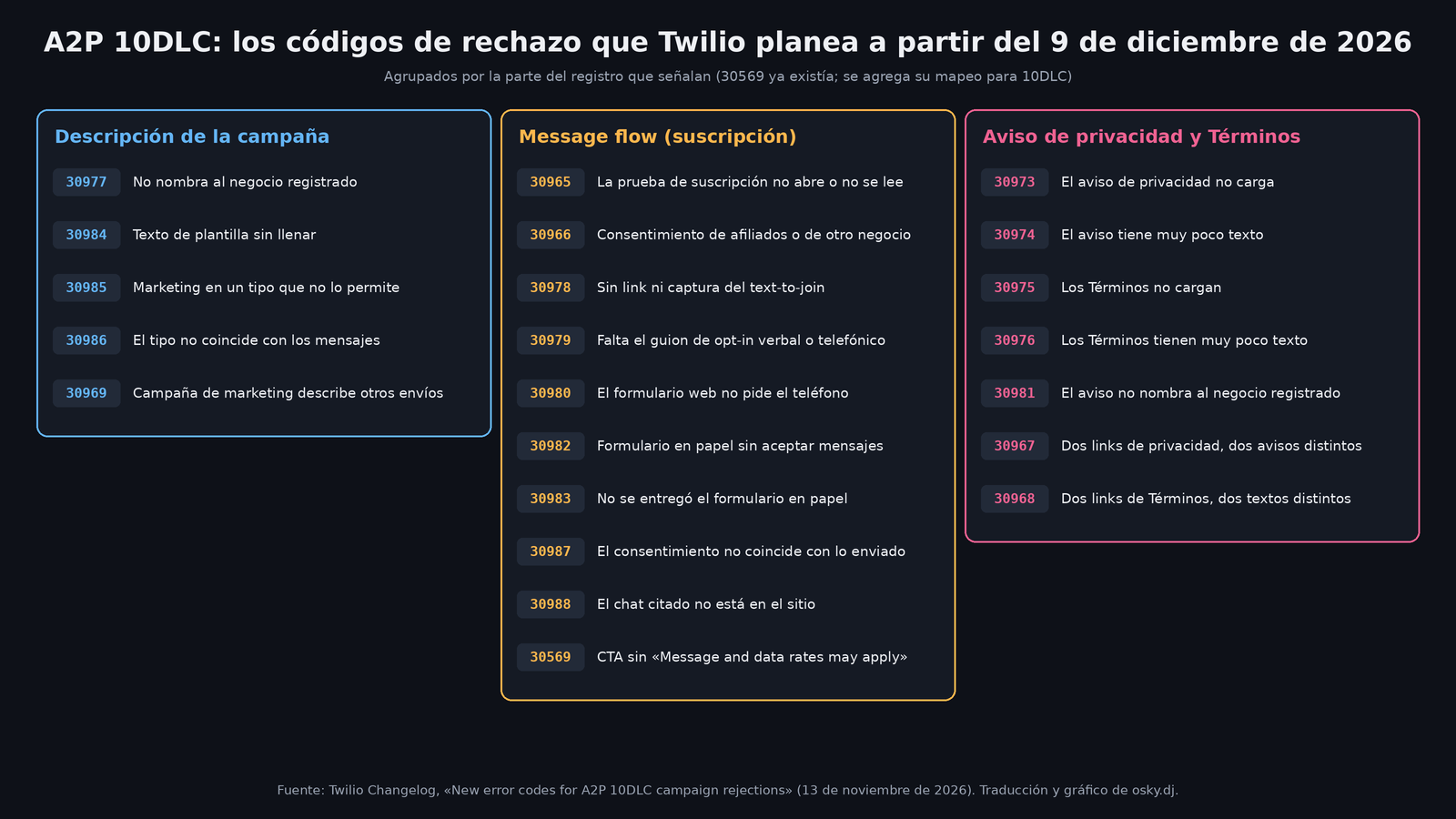
The changelog groups them into three blocks. Here they are with their meanings translated:
Campaign description
| Code | What it means |
|---|---|
| 30977 | The description doesn't name the business you registered |
| 30984 | The description has unfilled template text |
| 30985 | Marketing content in a campaign type that doesn't allow it |
| 30986 | The campaign type doesn't match the messages you describe |
| 30969 | A marketing campaign also describes non-marketing messages |
Message flow (how people opt in)
| Code | What it means |
|---|---|
| 30965 | The opt-in proof won't open or can't be read |
| 30966 | Consent was collected for affiliates or collected by another business |
| 30978 | No link or screenshot of the text-to-join instructions |
| 30979 | The verbal or phone opt-in script is missing or incomplete |
| 30980 | The website's opt-in form has no phone number field |
| 30982 | The paper form doesn't ask people to agree to receive messages |
| 30983 | The paper form wasn't provided |
| 30987 | The consent doesn't match the messages the campaign sends |
| 30988 | The chat you mention in the message flow isn't on your site |
| 30569 | The CTA doesn't include the message and data rates disclosure |
Privacy Policy and Terms and Conditions
| Code | What it means |
|---|---|
| 30973 | The Privacy Policy page didn't load |
| 30974 | The Privacy Policy has too little text |
| 30975 | The Terms and Conditions page didn't load |
| 30976 | The Terms and Conditions have too little text |
| 30981 | The Privacy Policy doesn't name the business you registered |
| 30967 | Two links to the Privacy Policy open different policies |
| 30968 | Two links to the Terms open different terms |
The 30569 case shows just how picky the review is. Its documentation page clarifies that the problem is that the CTA, where the person gives consent, doesn't warn that message and data rates may apply. If that disclosure is only in the Terms, it doesn't count for this error: another code, 30562, covers that. Twilio's suggested fix is to put the exact phrase "Message and data rates may apply" in the CTA.
What you can already see today
I checked the changelog's links on November 14, 2026. The pages for 30973, 30974, 30975, and 30976 are already published in the documentation, but they describe them as warnings (WARNING level) from a check done before the campaign is submitted: according to the text of 30973, you can still submit it, although reviewers may reject a policy they can't open. The pages for the other seventeen new codes don't open yet (they return 404).
The ones already published offer concrete clues. 30973 lists possible causes: a broken or misspelled link, a policy that requires login, a CAPTCHA or "verify you're human" screen blocking the reviewer, or a link that opens a PDF instead of a web page. 30976 flags as "too little text" a page that only shows a heading, a summary, or a "coming soon," or where the terms are in an image, in a pop-up, or in a collapsed section.
That last one hits right at anyone who puts their site behind an anti-bot challenge: the same Cloudflare that protects you can leave the reviewer on the wrong side of the door. My take: if you register campaigns, open your privacy and terms links in a private window before submitting, as Twilio recommends, and check that they aren't behind a challenge.
Why it matters if you build bots
A WhatsApp bot doesn't go through A2P 10DLC; a bot that sends SMS to US numbers from local numbers does. That's where SMS verification codes, appointment or order notices, and flows where SMS is the fallback when the other channel doesn't get through all land.
Where it matters most, as I read it, is on platforms that register campaigns on behalf of their clients. There the rejection doesn't reach whoever wrote the privacy policy, but whoever integrated the API, and a generic code forces back-and-forth with the client until you guess what failed. With a code that says "your web form has no phone field" or "your two privacy links open different policies," the message for the client practically writes itself.
What to do in your code
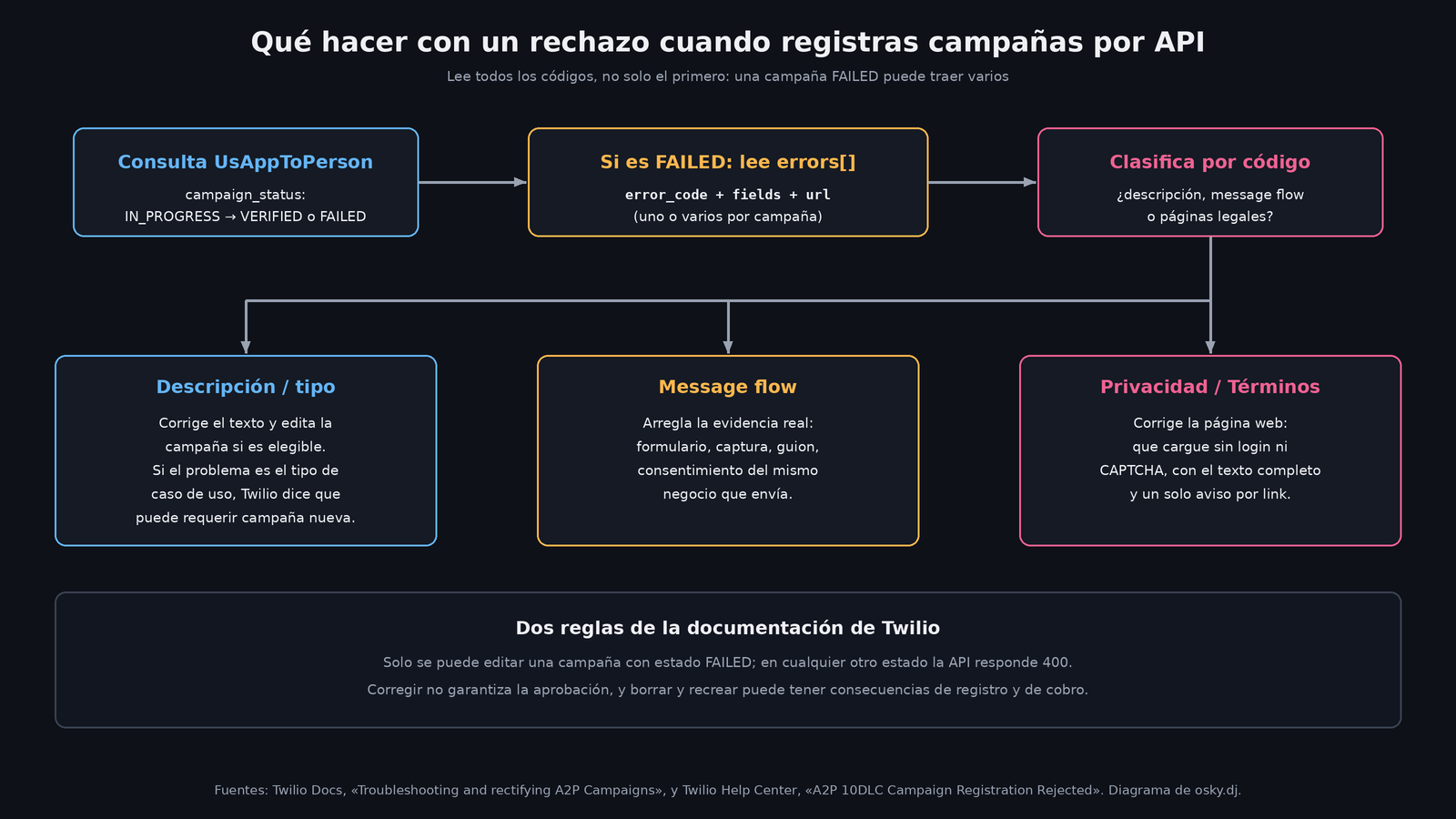
The Twilio troubleshooting guide explains that when you query the UsAppToPerson resource, the campaign_status field moves from IN_PROGRESS to VERIFIED or FAILED. When it's FAILED, the errors property carries at least one error, and possibly several, each with error_code, fields (the flagged field, for example USE_CASE_DESCRIPTION or SAMPLE_MESSAGE_1), url, and description.
With that, here's what's practical before December 9:
- Don't assume a single error. Loop through the whole
errorsarray and show all of it; Twilio asks you to review every code it returns. - Don't write a closed
switchover the codes you know. If your system translates codes into messages for the client, leave a default case that uses theurlanddescriptionTwilio sends. That way a new code doesn't turn into "unknown error." - Use
fieldsto point at the field in your onboarding form, instead of showing the rejection as a block of text. - Split by where it gets fixed. Description issues are fixed in the campaign; message flow issues, in the opt-in evidence; privacy and terms issues, on the client's website.
And three rules from the documentation worth keeping handy:
- According to the troubleshooting guide, you can only edit a campaign in
FAILEDstatus; in any other status the API responds with a 400 error. - The changelog warns that some fixes require a new campaign with the right type, and that an existing campaign is only resubmitted when it's eligible.
- The help article says that fixing doesn't guarantee approval and that deleting and recreating a campaign can have registration and billing consequences.
I haven't tested it; all of this comes from Twilio's official documentation and its changelog.
What we still don't know
- Whether the date holds. Twilio talks about a plan, not a confirmed rollout.
- How warning and rejection coexist. Today 30973 through 30976 are documented as pre-submission warnings; the changelog lists them among the rejection codes. We'll have to see how their pages look after December 9.
- What happens with the generic codes. The announcement doesn't say whether earlier rejections (like 30886 for invalid description) stop being used or keep arriving alongside the new ones.
- The fix guides for seventeen of the codes, which aren't published yet.
Sources
- Twilio Changelog: New error codes for A2P 10DLC campaign rejections (November 13, 2026)
- Twilio Help Center: A2P 10DLC Campaign Registration Rejected
- Twilio Docs: Troubleshooting and rectifying A2P Campaigns
- Twilio Docs: error 30569
- Twilio Docs: error 30973
- Twilio Docs: error 30976
- Twilio Docs: errors and warnings dictionary