/en/articles/claude-fable-5-2-arrives-with-1m-context-and-lower-pricing-but-it-brings-four-changes-that-can
Claude Fable 5.2 arrives with 1M context and lower pricing, but it brings four changes that can break your code

On November 9, 2026, Anthropic launched Claude Fable 5.2 and Claude Mythos 5.2, the new version of its most powerful models. They are the same model with two different access keys: Fable is open to anyone, with cybersecurity and biology locks, and Mythos is reserved for verified organizations. Both have a context window of 1 million tokens, up to 128k output tokens, and adaptive reasoning that can't be turned off. They're also cheaper than the previous version: $8 per million input tokens and $40 per million output tokens, versus $10 and $50 for Fable 5.1. For anyone building agents, automations, or code with the Claude API, the news comes with fine print: there are four changes that can break your integration if all you do is swap the model name.
What Anthropic announced
According to the official announcement, Fable 5.2 and Mythos 5.2 improve at coding, reasoning, and vision. Anthropic says they generate responses up to 30% faster than the 5.1 generation and that they "communicate more clearly" than previous Fable and Mythos models.
The technical details, according to the Claude Platform release notes and the What's new in Claude Fable 5.2 page:
- API IDs:
claude-fable-5-2andclaude-mythos-5-2. - Context: 1M tokens (it's both the default and the maximum). Output: up to 128k tokens.
- Reasoning: adaptive and always on. Depth is controlled with the
effortparameter, which has five levels (low,medium,high,xhigh, andmax). The default in the API ishigh. - Fast mode: with
speed: "fast"in the request, no beta header needed, generation is up to 2.5 times faster, at $16 per million input tokens and $80 per million output tokens. - Availability: Fable 5.2 is on the Claude API, Claude Platform on AWS, Amazon Bedrock, Google Cloud (both the Anthropic-managed and Google-managed versions), and Microsoft Foundry.
- Data retention: same as the 5.1 generation, both models require 30-day retention. They are not available with zero retention unless Anthropic expressly authorizes it.
Mythos 5.2 has the same capabilities, but only those who go through a verification program get in, such as the Cyber Verification Program or the life sciences one. The difference is in the safeguards: according to Anthropic, Fable blocks most cybersecurity tasks.
The numbers (and who's providing them)
Anthropic published a table in which Fable 5.2 lands above Opus 5.5 "in almost all" the capabilities it evaluated. A few examples: 49.1% on FrontierCode 2.0 (agentic programming, at xhigh effort) versus 45.5% for Opus 5.5 and 42.8% for GPT-6 Astra. On the Remote Labor Index, which measures real remote work, it goes from 17.9% with Fable 5.1 to 41.3%. On RoboDojo Sim, simulated robot control, it climbs from 27.6% to 64.9%.
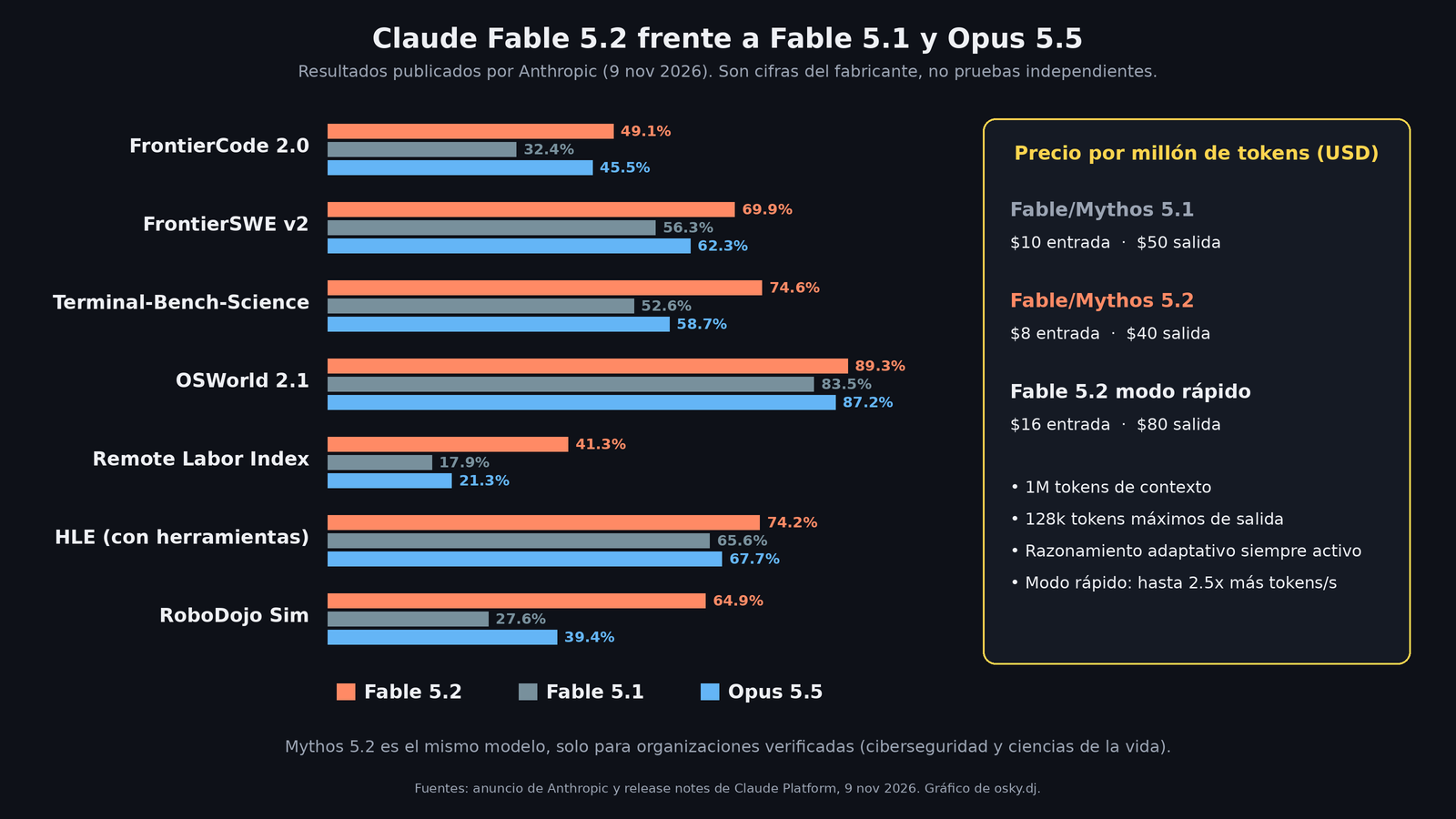
This needs to be read calmly: these are the manufacturer's figures, run by the manufacturer. An external data point that does exist comes from Artificial Analysis, which gives Fable 5.2 at maximum effort 65 points on its intelligence index, first place on its table, with a median of 40 for comparable models. The same page shows the flip side: in that configuration it's among the slowest, at 44.6 minutes per task versus a median of 12.7. It's also very verbose: it generated 275 million output tokens in the evaluation, versus a median of 72.8 million. And it cost $26.54 per task.
Anthropic also touts some eye-catching cases, which are worth separating from what can be verified:
- An engineer asked it to design an operating system from an empty folder. According to the company, the model coordinated more than 1,000 subagents over eight days and produced a system that boots on a laptop, with drivers, a file system, windows, and an installer.
- A team of 1,000 Fable 5.2 agents formalized the proof of Fermat's Last Theorem in Lean in 30 hours. With the same setup, Opus 5.5 completed 26% in 18 hours.
- It says that more than 90% of the changes merged into Anthropic's codebase are already written by Claude, with human guidance.
Heads up: it's not just swapping the model name
Here's what matters to anyone with code in production. The documentation lists four changes compared to Fable 5.1 that can break an integration. All of them respond with a 400 error:
- The prefix check applies to all accounts. If your code edits the
system, thetools, or an earlier message and then resends a thinking block from a later turn, the API respondsThe block is bound to a different conversation. On Fable 5.1 that only happened on accounts created since August 31, 2026. In other words, code that works today on an old account can blow up as soon as you switch models. - Its thinking blocks can only be read by Fable 5.2 and Mythos 5.2. If a router or a fallback sends the conversation to Opus 5.5 or Fable 5.1, the API discards that reasoning. The request doesn't fail, but context is lost.
- Goodbye
computer_20251124. For computer use you have to declare thecomputer_toolset_20260801toolset. The old tool only keeps working on Amazon Bedrock. - Advisor tool: if the executor is Fable 5.2, the advisor has to be Fable 5.2 or Mythos 5.2. Any other, including Fable 5.1, throws an error.
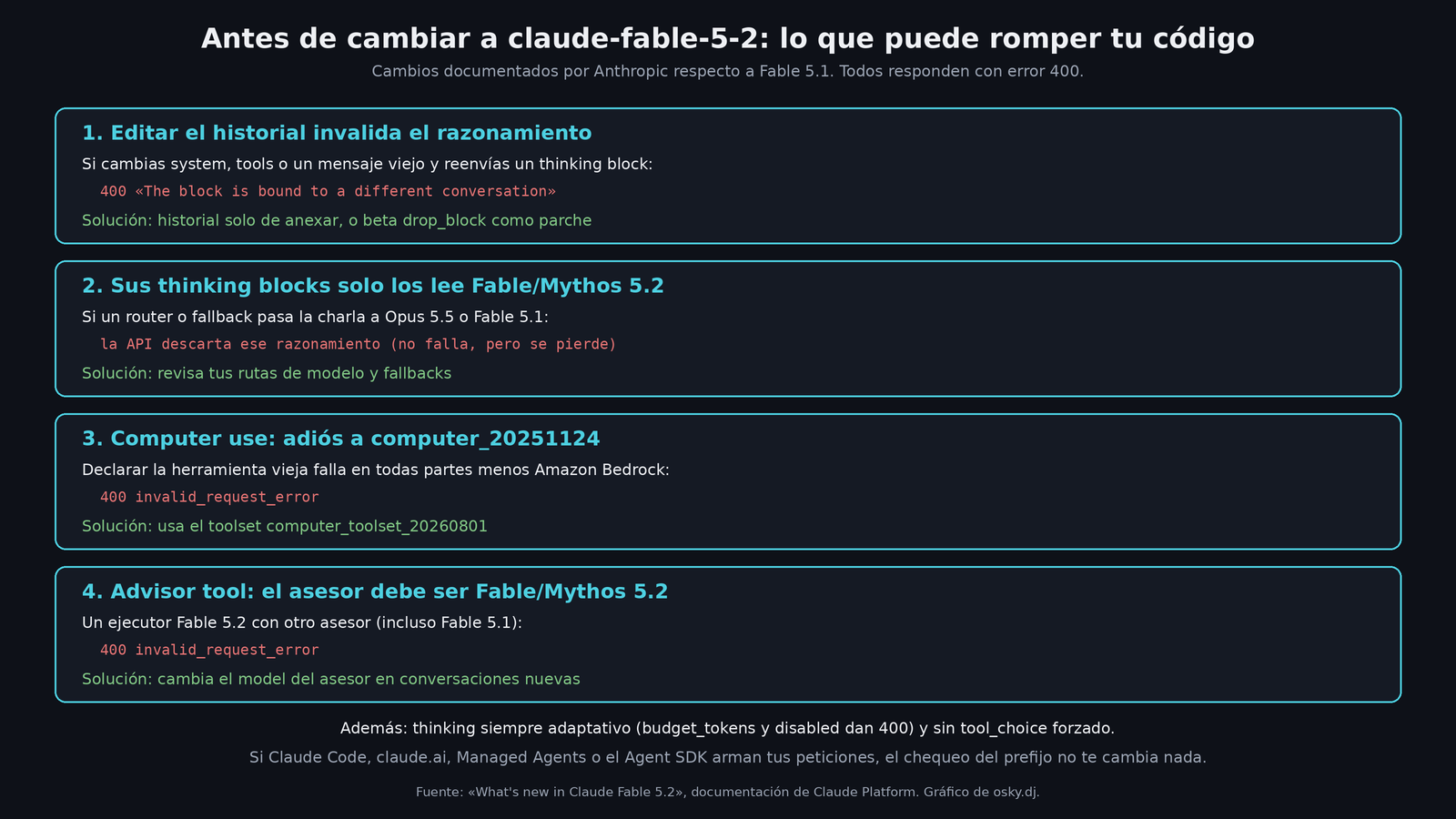
There are two more rules that aren't new if you're coming from Fable 5.1 or Opus 5.5, but are if you're coming from older models. The first: thinking with budget_tokens or set to disabled returns an error. The second: forcing the use of a tool with tool_choice isn't allowed. To get valid JSON, the documentation recommends strict: true or structured outputs.
The good news: according to Anthropic, if your requests are built by Claude Code, claude.ai, Claude Managed Agents, or the Claude Agent SDK, the prefix check changes nothing for you. It also doesn't affect you if your code keeps the history append-only: you never edit, reorder, or delete earlier messages, and you resend each assistant turn exactly as it arrived.
Who is it for?
This is my take, not Anthropic's advice: for most projects, Fable 5.2 shouldn't be the default model. And the funny thing is that the company itself thinks along similar lines. In its announcement it recommends starting with Claude Opus 5.5 for most coding and knowledge tasks, and moving up to Fable or Mythos only when needed. The documentation says it more bluntly: use Fable 5.2 when your evaluations with Opus at high effort still don't deliver what you need.
Where the equation can change is on long, hard jobs: code migrations, audits, agents that work for hours unsupervised. That's where Anthropic's cost figure comes in: on FrontierCode 2.0, Fable 5.2 at high effort ties the best Opus 5.5 result (45.3% versus 45.5%) for roughly half the cost per task. If that holds up on real workloads, the "expensive" model could end up cheaper than squeezing the middle one. But only your own tests can tell you that.
It can also be used as an advisor: a small model like Haiku, Sonnet, or Opus consults it when it gets stuck. For a bot or an automation, that setup lets you pay Fable prices only on the hard questions.
What to do if you use the Claude API
I haven't tested it; this comes from Anthropic's official documentation.
- Don't blindly swap the ID in production. First check whether your code edits the history, even if Fable 5.1 never gave you the error.
- Review routers and fallbacks. If you mix models in the same conversation, expect Fable 5.2's reasoning to be lost when switching to another one.
- Migrate computer use to the new toolset and update the advisor if you use the advisor tool.
- Rerun your evaluations with an
effortsweep that starts athigh, as the guide suggests. Savemaxfor measuring the model's ceiling. - If you need a quick patch, there's the beta option
prefix_mismatch_behavior: "drop_block", which discards invalid blocks instead of failing. The documentation makes clear it should be temporary, because it can increase output tokens.
Sources
- Anthropic: Introducing Claude Fable 5.2 and Claude Mythos 5.2 (official announcement, November 9, 2026)
- Claude Platform: release notes, November 9, 2026
- Claude Platform: What's new in Claude Fable 5.2
- Artificial Analysis: Claude Fable 5.2 (Max), intelligence, speed, and price analysis
- Anthropic: Cyber Verification Program