/en/articles/chatgpt-wallet-openai-lets-its-agents-pay-with-your-card-without-ever-seeing-it
ChatGPT Wallet: OpenAI lets its agents pay with your card without ever seeing it

OpenAI introduced ChatGPT Wallet on November 13, 2026: a wallet that lets ChatGPT agents pay for purchases on the user's behalf without seeing the real card details, with a biometric check on every purchase. It was built with American Express, Mastercard and Visa, and it launches in a limited way inside dots, its "always-on" agents, for ChatGPT Pro subscribers in the United States. For people shopping from Mexico, nothing changes yet. For anyone who runs an online store, or manages the firewall for one, quite a bit more changes: traffic from agents that buy things is no longer a lab experiment, and it shows up with a credit card in hand.
How a purchase works
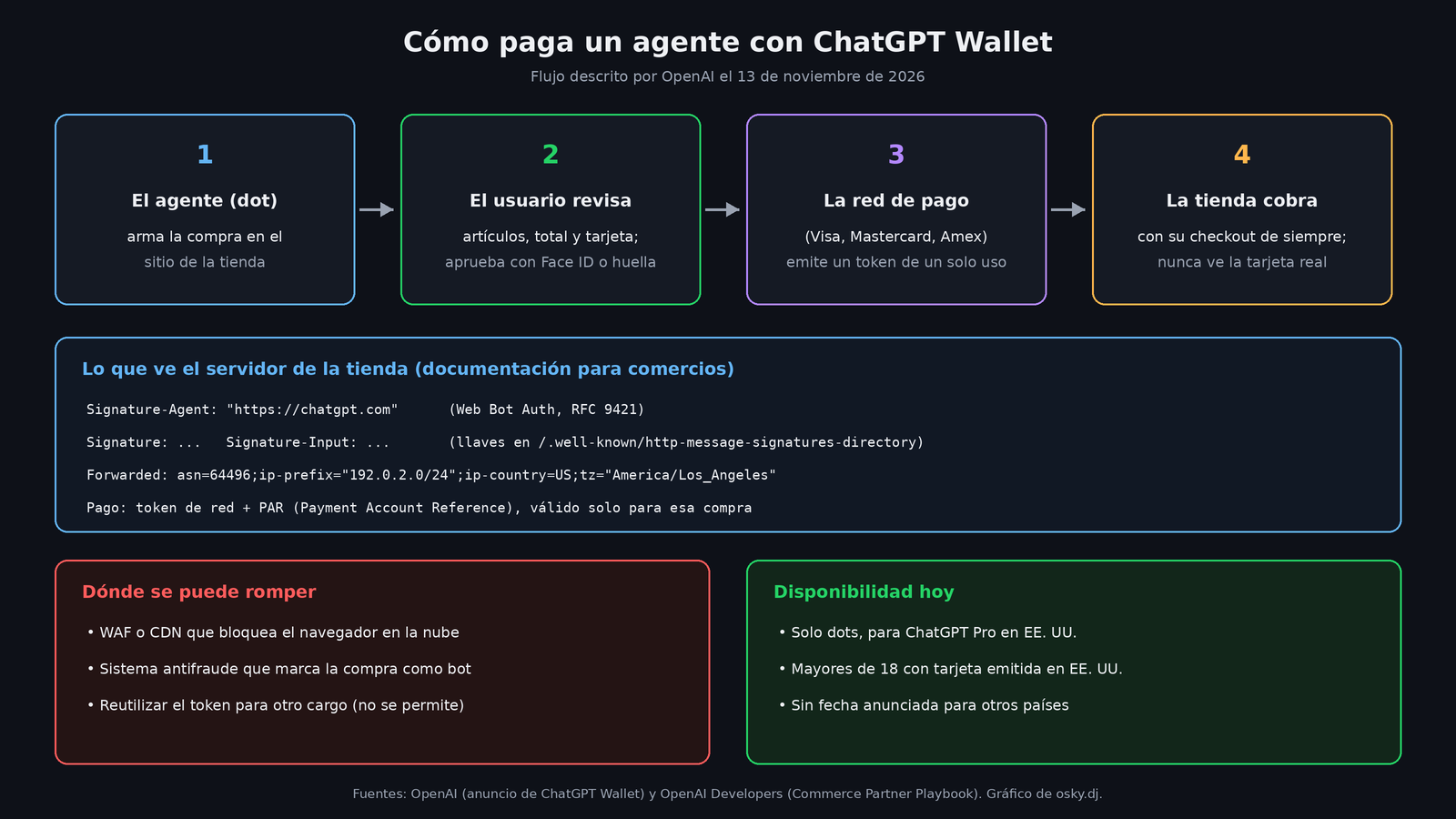
According to OpenAI's announcement, the user adds a card once. Every time their agent is about to buy something, it shows them the items, the total and the chosen card, and the user approves with a security check like Face ID or a fingerprint. Each approval leaves a record of what the user authorized.
After approval, the payment network issues a token: a stand-in for the card with its own number, security code and expiration date. The charge lands on the user's real card, but neither the agent nor the store sees its details. OpenAI says the user keeps their card rewards and protections for eligible disputes, for example if a defective product shows up, and that the store remains in charge of pricing, shipping, returns and customer support.
The merchant guide adds details the announcement doesn't include:
- Nothing Wallet-specific needs to be integrated. It works with the checkout pages and forms the store already has.
- The store receives a network token, not the full number. To tie it to the back-end account, it uses the Payment Account Reference (PAR).
- The token is only good for that one purchase. OpenAI asks that you not store it or reuse it for another charge. Subscriptions are allowed if the checkout already handles recurring billing and the customer gives consent.
As for the future, OpenAI writes that it expects users to be able to fully delegate purchases with clear rules: spending limits, categories or time periods, pre-approved with stronger safeguards. That doesn't exist today: every purchase asks for your fingerprint.
Where it's going to get stuck: firewalls and anti-fraud
The most honest part of the announcement is the one admitting this doesn't work everywhere yet. OpenAI acknowledges that "some sites may unintentionally block" purchases made with Wallet or with other agentic payment products. The reason is simple: dots agents buy from a cloud browser, and that browser looks an awful lot like a bot, because technically it is one.
For that, it published the Commerce Partner Playbook. What matters for whoever runs infrastructure:
1. Signed identification with Web Bot Auth
According to the agent access guide, requests from ChatGPT's cloud browser are signed with Web Bot Auth, which uses the HTTP message signatures standard (RFC 9421). Each request carries the Signature, Signature-Input and Signature-Agent headers, the latter with the value "https://chatgpt.com". The public keys to verify them are at chatgpt.com/.well-known/http-message-signatures-directory.
OpenAI says Akamai, Cloudflare, HUMAN and Vercel verify those signatures on their own. In Cloudflare the traffic shows up as "dots, OpenAI" under Personal Agents, in the access policies for crawlers and agents. You can also allow it with a WAF rule using detection ID 129220581. With any other provider, you have to verify the signature by hand before opening an exception.
An important detail: that permission does not affect OpenAI's crawlers, such as OAI-SearchBot. They're separate things, so you can let in the agent that buys and keep blocking the one that indexes, or the other way around.
2. User signals in the Forwarded header
The trickier problem is anti-fraud. Risk systems look at the IP and the browser, and a cloud browser sends signals that aren't the customer's. According to the payments guide, OpenAI is starting to forward user signals in the Forwarded HTTP header: autonomous system number (asn), observed IP (for), masked network prefix (ip-prefix), estimated country (ip-country), language (locale), time zone (tz) and the user's browser or app (user-agent). If you have your own risk engine, the recommendation is to start reading that header. If you use a third-party one, ask your provider whether it already takes it into account.
OpenAI also says it's working with Forter, Riskified, Sardine and Signifyd on fraud prevention, and with Adyen, Checkout.com and Stripe on processing, so they recognize these purchases as legitimate.
3. Feeds, plugins and WebMCP
The rest of the playbook is optional: claim your business profile in ChatGPT and upload a product feed with prices and stock, build a plugin (via MCP) so the agent can check inventory or manage carts, or add WebMCP tools to the site. The guide makes clear that the cloud browser doesn't need a feed or a plugin to buy on a site. Those pieces just make it faster and more accurate.
Who answers if something goes wrong
In the FAQ of the access guide there are two answers worth reading carefully. One: the store still can't require human confirmation for specific actions like checkout. OpenAI says it asks for human review before any important action, but that's controlled by OpenAI, not the merchant. Two: for payment or order errors, "customers are ultimately responsible for the actions they take," so support is handled the same as if the customer had bought it themselves.
My take: OpenAI built this conservatively on the technical side. It uses network tokens that already exist, unchanged checkout and biometrics on every purchase, and it offloads responsibility to the user and the store. That's sensible for a start. The delicate part comes when delegation without per-purchase approval is switched on. At that point the record of "what the user authorized" is going to carry a lot of weight in every chargeback, and we don't yet know how banks will treat it.
Context: they're not the only ones
OpenAI isn't the first to get into this. According to Cointelegraph, Google introduced its Agent Payments Protocol in 2025, Visa and Mastercard have their own agent-initiated payment initiatives, and in the crypto world Coinbase launched the x402 protocol and Circle its Agent Stack. What OpenAI puts on the table is scale: according to its announcement, 1.2 billion people use ChatGPT every week, and many already use it to research and compare products before buying.
Availability
ChatGPT Wallet began rolling out on November 13 in dots, only for ChatGPT Pro subscribers over 18 in the United States with cards issued in that country. OpenAI says it will expand availability as it learns from real-world use, but it gave no dates or countries.
If you sell online from Mexico, you don't have to change anything today. But if your store sits behind Cloudflare or a strict WAF, it's worth checking how it treats signed agents before the customers who shop through one arrive. This comes from OpenAI's official documentation; I haven't tested it.
Sources
- OpenAI: Introducing ChatGPT Wallet (official announcement)
- OpenAI Developers: Accept payments (Commerce Partner Playbook)
- OpenAI Developers: Help ensure cloud browser access to your site
- OpenAI Developers: Commerce
- OpenAI: Introducing dots
- RFC 9421: HTTP Message Signatures
- Cointelegraph via TradingView: OpenAI launches AI payments in ChatGPT with Visa, Mastercard and Amex