/en/articles/anthropic-lets-you-run-all-of-claude-managed-agents-on-your-own-servers
Anthropic lets you run all of Claude Managed Agents on your own servers
Anthropic announced on November 12 in its platform release notes that you can now run the full Claude Managed Agents stack on your own infrastructure: not just the sandboxes where the agent runs commands, but also the service that runs the agent loop and stores agents, sessions, and history. The model can still be Claude through the Anthropic API, or go through Amazon Bedrock, Google Cloud, Microsoft Foundry, or your own gateway. For anyone building agents inside companies with strict data rules, this changes the conversation with the security team: transcripts no longer have to live on third-party servers. Heads up: it's not a free download; access has to be requested from Anthropic's accounts team.
What exactly can be self-hosted
Managed Agents is Anthropic's service for running Claude as an autonomous agent: you define an agent, open a session, and exchange events while it works with its tools. According to the self-hosted version's documentation, the system has two pieces you can move to your side:
- Sandboxes: the containers, VMs, or isolated spaces where the agent runs shell commands and works with files. This already existed as self-hosted sandboxes, but the service and the history were still at Anthropic.
- The service: the API, the agent loop, and the storage for agents, sessions, and history. This is the new part.
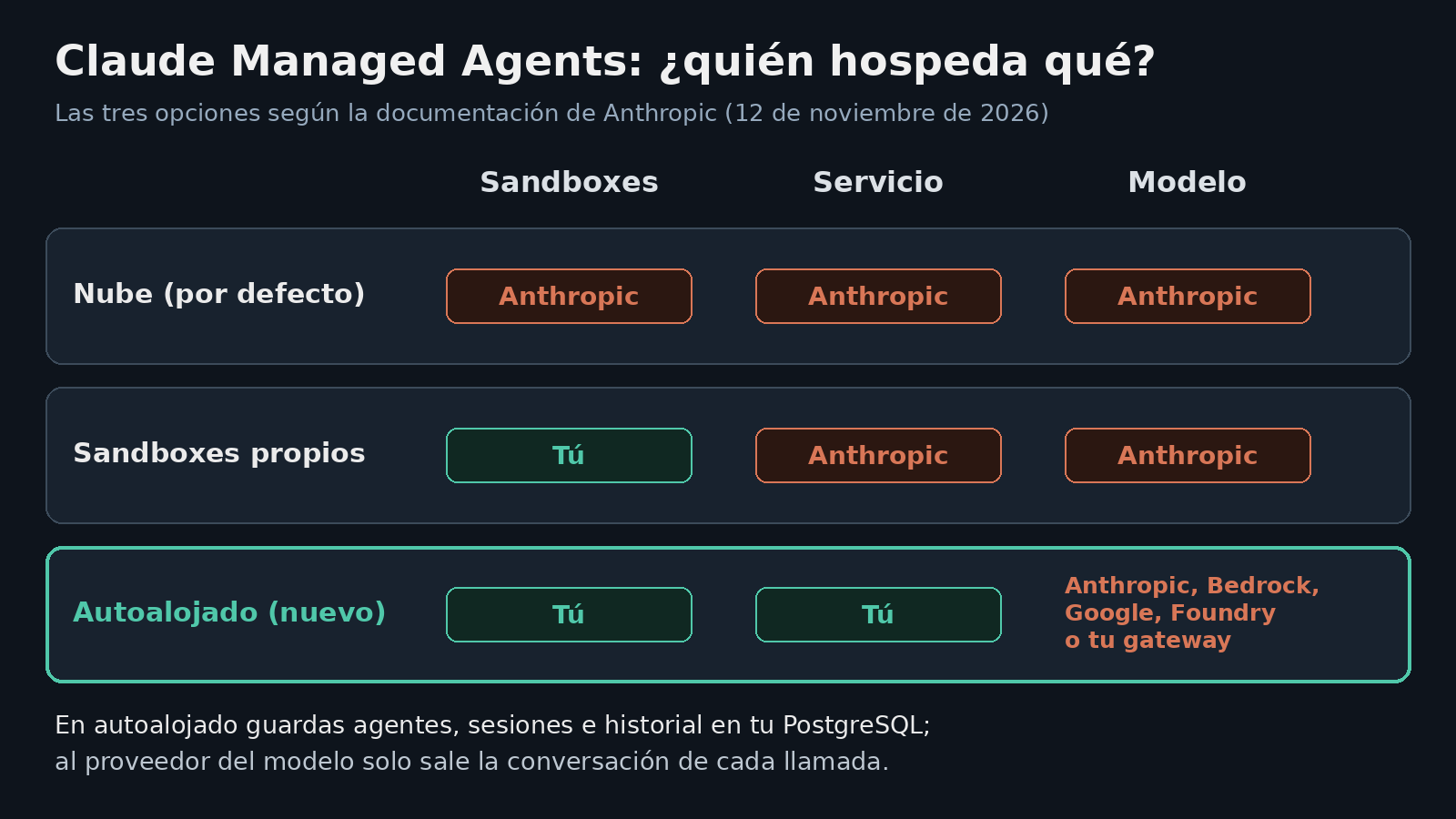
The documentation sums it up in three scenarios: everything in Anthropic's cloud (the default), your own sandboxes with the service and model at Anthropic, and the self-hosted version, where sandboxes and service are yours and the model runs at Anthropic or at the provider you choose.
How it's put together
A deployment is made up of several parts, according to the feature's main page:
cma-server: serves the API, runs the agent loop, and stores the data. It never runs the agent's shell or file tools itself.- Database: PostgreSQL 16 or later. Without a database, the server keeps everything in memory and a restart wipes it.
- Workers: programs that request work from the server and run the tools in your sandboxes (the
ant beta:workercommand or a worker built with the SDK). - Your own web console, with sign-in through your identity provider (SSO with OpenID Connect).
- An admin CLI (
cma-server-admin) for creating environments and their keys.
The API is the same as Anthropic's service, so the SDK and the ant CLI work when pointed at your server. The quickstart brings everything up on a single machine with Docker Compose (server, PostgreSQL, and workers that run each session in its own container) and requires a host with at least two CPUs. For production, Anthropic recommends the two Kubernetes Helm charts that come in the package. By default, the server listens on 127.0.0.1:8400, meaning only from the same machine.
There are three distinct credentials: your server's API key (used by your applications), the inference credential (held only by the server, to talk to the model provider), and the environment key, which workers use to pull work from their queue.
Choosing the model provider
The inference provider page lists five values for inference.provider: anthropic (the default), bedrock, vertex (Claude on Google Cloud managed by Google), foundry, and gateway, for a model gateway that you operate. Agents keep naming models with their Claude API ID (for example claude-opus-5-5) and the server translates it to each provider's ID.
The custom gateway accepts the Messages API format, the Bedrock format, or Google's rawPredict, and even short-lived tokens obtained through an OAuth exchange. It's the piece that will interest anyone who already centralizes model usage behind a corporate proxy.
What data leaves your network
The data and access page is written as an answer to a security review, and it's worth reading in full. The most relevant points:
- Every model call sends out the conversation up to that point, including tool inputs and results. That doesn't change: the model needs the context.
- If the provider is the Claude API, each call also carries the session, agent, and environment IDs in headers. Anthropic says they carry no names or content, and that there is no setting to turn them off. With other providers they aren't sent.
- The server identifies itself in the
User-Agentand can send thecma-servertag inmetadata.user_id, so Anthropic can count usage. - Anthropic states it has no remote access to the server or its logs. The server doesn't delete sessions by age: they stay in your database until you remove them.
- An important detail: Managed Agents in the cloud is not eligible for zero data retention (ZDR), because Anthropic stores the transcripts. In the self-hosted version you store them, and if your organization has ZDR, it covers the model calls like any other Messages call.
What doesn't come included
The list of differences from the managed service is long and worth reviewing before migrating:
- Only
self_hostedenvironments exist; there are no sandboxes in Anthropic's cloud. - There are no scheduled deployments, no "dreams", and no webhooks. Anthropic suggests launching sessions from your own cron.
- The Files API and
fileresources don't exist; files go in the worker's working directory. - The prebuilt
docx,pdf,pptx, andxlsxskills don't ship: you have to upload them as custom skills from the public repository. - Multiagent orchestration is limited to one coordinator with up to 20 subagents that you declare; no dynamic flows and no advisor.
web_searchandweb_fetchcome turned off until you enable them. Also,web_fetchonly works with theanthropicandfoundryproviders, andweb_searchwithanthropic,vertex, andfoundry.- MCP servers and Git repositories only connect if their hosts are on an allowlist.
- Nothing is copied over from the managed service: agents, skills, credentials, and memories are created anew.
My take
I haven't tried it; all of this comes from Anthropic's official documentation, and the software isn't even available for public download. That said, the move is clear: Anthropic no longer competes only with models, it competes with the agent "runtime," and it understands that banks, government, and healthcare won't upload their agents' full history to someone else's cloud. Opening the door to Bedrock, Foundry, or your own gateway is also a signal: they'd rather have you run their agent server with another provider's model than have you leave for another agent platform.
The cost is the usual one when something is self-hosted: you answer for the server, the database, the patches, and the security. The documentation is explicit that each trust level needs its own deployment, and that the environment key must not be left inside the sandbox, because with it you can read the events of all sessions in that environment. For a small team that just wants the code to run on its network, your own sandboxes remain the simplest option. This is for those who truly need the data to stay at home.