/en/articles/anthropic-is-retiring-claude-opus-4-8s-fast-mode-on-november-30-what-changes-when-you-migrate-to
Anthropic is retiring Claude Opus 4.8's fast mode on November 30: what changes when you migrate to Opus 5.5

On October 30, 2026, Anthropic announced that fast mode for Claude Opus 4.8 is deprecated and will be retired on November 30, 2026. From that date on, any request to claude-opus-4-8 with speed: "fast" will return an error. Anthropic's own recommended way out is to migrate to Claude Opus 5.5, which does keep fast mode. If you have an agent, a bot, or a coding tool that depends on Opus 4.8 spitting out tokens at full speed, you have one month to move. And the change is not just swapping the model name.
Watch what the announcement does not say: Claude Opus 4.8 as a model is still alive. Anthropic's deprecations page lists it as active, with retirement "no earlier than May 28, 2027." The only thing dying on November 30 is its fast mode.
What fast mode is and what gets switched off
According to the official documentation, fast mode runs the same model with a faster inference configuration: it delivers up to 2.5x more output tokens per second, without changing intelligence or capabilities. The improvement is in output speed, not in time to first token, and it's most noticeable with streaming. You enable it by setting speed: "fast" in the request to the Messages API, or in the agent's model object in Managed Agents.
On Opus 4.8, fast mode never left research preview: you had to send the beta header fast-mode-2026-02-01, and it was only available on the Claude API. By contrast, Anthropic took Opus 5.5's fast mode out of research preview on October 15: you no longer need to request access or send the beta header, and Opus 5.5 comes with a default usage limit for fast mode on the Start, Build, and Scale tiers. Since October 22 it's also available on Claude Models on Google Cloud (operated by Anthropic) and on Microsoft Foundry on Azure.
After November 30, the expected behavior is the one the documentation describes for any unsupported model: requesting speed: "fast" where it doesn't exist returns an error. There is no silent downgrade to normal speed. The only documented exception to that rule is Claude Opus 4.6, which runs at standard speed instead of failing, and it doesn't apply here.
The money: Opus 5.5 is cheaper
This is the nice part. According to Anthropic's pricing page, in dollars per million tokens:
| Model | Standard (input / output) | Fast mode (input / output) |
|---|---|---|
| Claude Opus 4.8 | $5 / $25 | $10 / $50 |
| Claude Opus 5.5 | $4 / $20 | $8 / $40 |
Opus 5.5's fast mode is 20% cheaper per token than Opus 4.8's. As before, the fast price applies to the whole context window, and the caching and data residency multipliers stack on top. Fast mode doesn't work with the Batch API or with a Priority Tier commitment.
My take: the price per token goes down, but that doesn't guarantee your bill goes down. I explain below, because that's where the trap is.
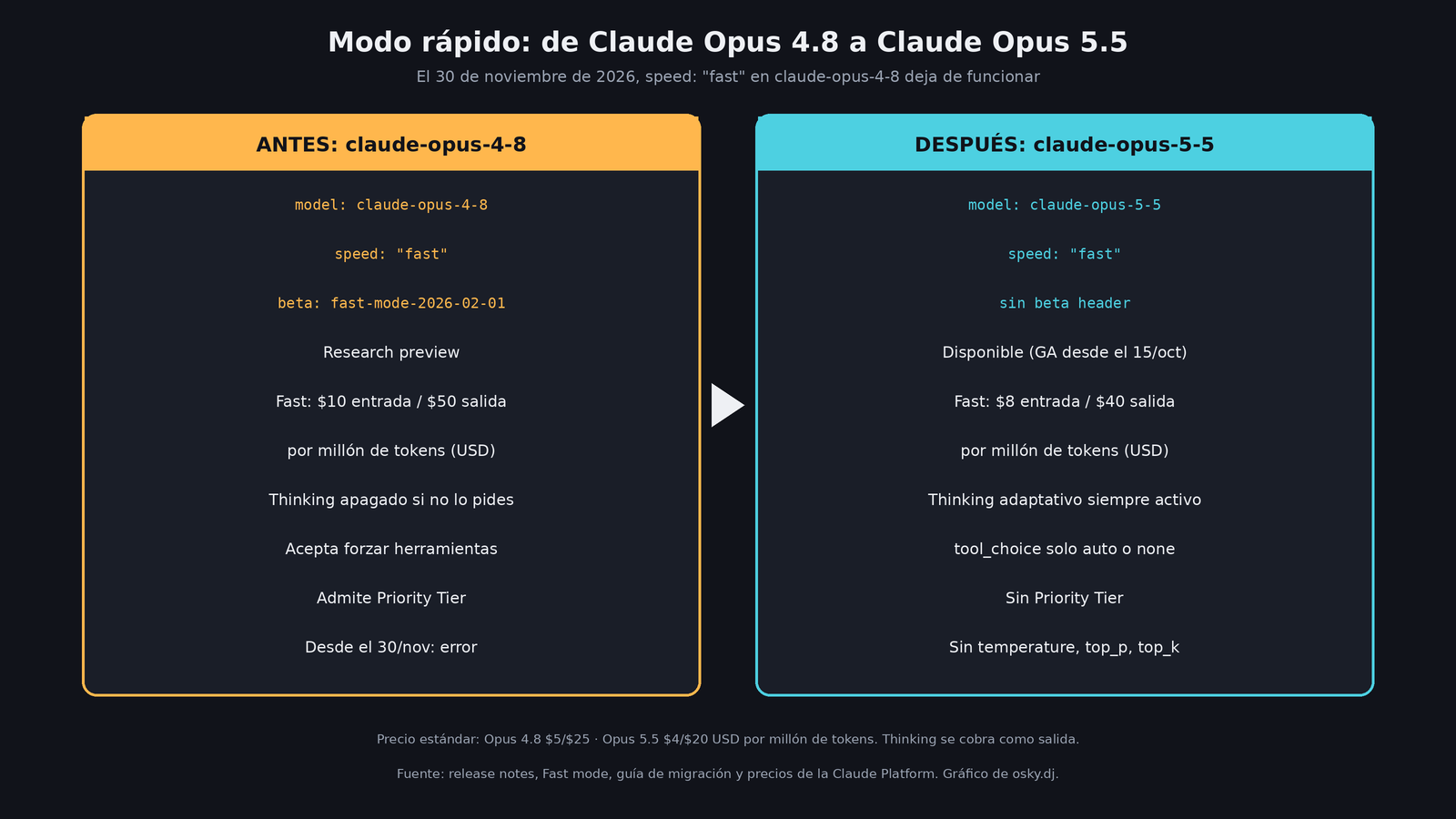
What breaks when you switch models
The official Opus 5.5 migration guide has a specific section for people coming from Opus 4.8, and the list is longer than a "just change the ID" would suggest. The important bits:
- Thinking can no longer be turned off. On Opus 4.8, a request without a
thinkingfield runs without reasoning. On Opus 5.5, adaptive thinking is always on.thinking: {"type": "disabled"}and manual budgets (budget_tokens) return a 400 error. Depth is controlled only through theeffortparameter (low,medium,high,xhigh,max), and the default ismedium, whereas Opus 4.8 defaults tohigh. max_tokensnow covers reasoning and text. Thinking tokens are billed as output even though you don't see their text. A flow that ran without reasoning on Opus 4.8 may generate more output tokens per request on Opus 5.5. That's why the lower price per token doesn't automatically translate into savings.- Responses start with
thinkingblocks. Code that readscontent[0].textbreaks. You have to select blocks by theirtype. In tool loops, thinking blocks are passed back complete and unmodified; if you edit, reorder, or filter them, the API responds with a 400. - You can't force tools.
tool_choicewithanyortoolreturns a 400. Onlyautoandnoneare accepted; the guide recommends using strict tool use or structured outputs. temperature,top_p, andtop_kare gone, and assistant prefill isn't accepted either.- Computer use changes tools: on the Claude API you have to declare the
computer_toolset_20260801toolset instead ofcomputer_20251124. - No Priority Tier. Opus 4.8 keeps it; Opus 5.5 doesn't support it. If your organization has that commitment, Anthropic asks you to plan capacity separately.
There are also changes in your favor: the minimum for caching a prompt drops from 1,024 to 512 tokens, and the 1-million-token context window comes by default with no beta header.
Who this hits
The osky.dj audience should care in three specific cases:
- Bots and conversational agents that use Opus 4.8 in fast mode to respond in real time, for example on WhatsApp or in a support widget. There, output speed is the user experience. On November 30 those requests start failing if you haven't migrated.
- Coding tools and automations that send the
fast-mode-2026-02-01header with Opus 4.8. That header stops working for Opus 4.8, and on Opus 5.5 it's no longer needed (if you keep sending it, nothing happens). - Anyone with a badly built fallback. If your code catches errors to retry, make sure a fast mode error doesn't end up in a retry loop. For usage limits (429), the documentation suggests retrying without
speed: "fast"; the error for an unsupported model is a different thing and retrying won't fix it.
What to do before November 30
What this means in practice, according to the official documentation (I haven't tested it in production code; this comes from Anthropic's docs):
- Search your code for
claude-opus-4-8alongsidespeedor thefast-mode-2026-02-01header. - Change the model to
claude-opus-5-5and remove the beta header. - Remove
thinking: disabled,budget_tokens,temperature,top_p,top_k, and the prefill. Seteffortexplicitly. - Replace forced
tool_choicewithautoplus strict tool use or structured outputs. - Read responses by
typeand pass thinking blocks back intact in tool loops. - Review
max_tokensand re-measure cost and latency with theeffortyou choose. Check that the response includesusage.speed: "fast"to confirm fast mode was actually applied.
The guide also mentions that Claude Code can do the migration with the command /claude-api migrate this project to claude-opus-5-5.
My opinion: Anthropic is pushing hard toward Opus 5.5, with a cheaper model, fast mode out of beta, and a month of notice. The notice is short, but the path is well documented. What's going to break the most won't be fast mode itself, but the code that took for granted that the model doesn't reason before answering.